NatureLandscapes7 designsFree to print
print, color, learn
Free Rainforest Coloring Pages
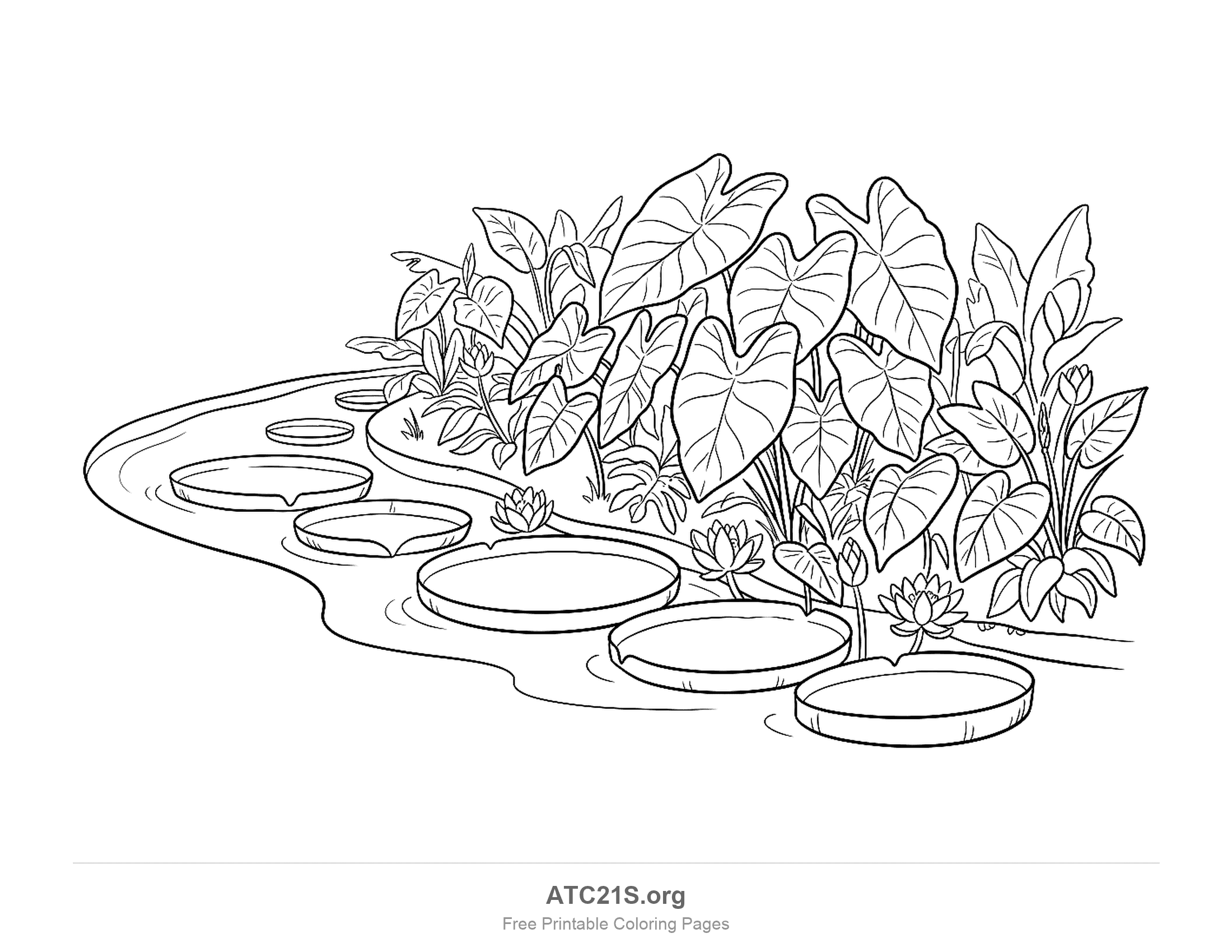
Seven free printable rainforest coloring pages, from giant lily pads on a jungle river drawn in bold, open shapes for little hands to a dense jungle canopy hung with looping vines for older kids. Download the PNG or print straight from this page.
share:
pick a favourite
7 Rainforest designs to color
Tap any sheet for a closer look, then download or print it.
Rainforest Coloring Page - Passion Flower Vine
Rainforest Coloring Page - Bamboo And Fan Palms
Rainforest Coloring Page - Vine Wrapped Tree Trunk
Rainforest Coloring Page - Orchids And Bromeliads On A Branch
Rainforest Coloring Page - Curling Fern Fronds
Rainforest Coloring Page - Dense Jungle Canopy
quick instructions
How to download and print
1. Pick your sheet
Preview any design below and choose the one you like best.
2. Print or download
Print straight from the page, or save the PNG to print later.
3. Color it in
Crayons, colored pencils or markers — plain paper works fine.
Every sheet is sized for landscape US Letter (11" x 8.5") at 200 DPI, so it fills the page without cropping. A4 works too — choose "fit to page" when printing.
while you color…
6 fun facts about the rainforest
Tropical rainforests cover only a small part of the Earth's land, but about half of all the kinds of plants and animals on land live in them.
The Amazon is the biggest rainforest in the world. It stretches across parts of nine countries and territories in South America.
The giant water lily of the Amazon has round leaves that can grow up to about 3 metres (10 feet) across, wider than a grown-up is tall.
Bamboo is a kind of grass, and some bamboos can grow almost a metre (about 3 feet) in a single day.
A bromeliad's leaves form a little cup that holds rainwater, and tiny frogs raise their tadpoles in these pools high up in the trees. The pineapple is a bromeliad too.
Vanilla, the flavour in ice cream, comes from the seed pods of an orchid that climbs rainforest trees.
About the rainforest coloring page
A rainforest is a forest that is warm and wet all year round. Tropical rainforests grow near the equator, in the Amazon of South America, the Congo Basin in Africa and the islands of South-East Asia, and they get so much rain and so little winter that plants never stop growing. The result is the jungle children know from stories and films: giant leaves, hanging vines, flowers in the treetops and a green so thick you can hardly see the sky. A rainforest sheet lets them fill a page with all of that, and this set covers seven corners of the jungle: a slow river, a flowering vine, a bamboo thicket, a vine-wrapped trunk, a branch full of orchids, a spray of ferns and the whole crowded canopy.
Real rainforests are green on green on green: pale new leaves, dark glossy old ones, yellow-green moss and blue-green ferns, with brown bark and dark, wet soil underneath. The flowers are where the colour hides. Orchids come in white, pink, purple and yellow, bromeliads have red or orange centres, and a passion flower is often purple and white with a fringed ring of blue. It makes a good starting point, and any colour is welcome: a purple jungle or a rainbow river is still a jungle. What makes a picture read as a rainforest is huge leaves, especially the split, holey leaves of the monstera, and vines that loop and climb. Most sheets have both, so younger children can start with the biggest leaves and work inward.
The seven designs get steadily harder. First is a slow jungle river curving across the page, with round giant lily pads floating on it, each with a turned-up rim, a few water lily flowers and buds, and a bank thick with big heart-shaped elephant-ear leaves, all in bold lines with wide open spaces for younger children. Next is a passion flower vine winding from one side of the page to the other, with two open flowers, each with a fringe of fine threads around a crown in the middle, plus fat buds, curly tendrils and lobed leaves. The third sheet is a clump of bamboo, tall jointed canes with small pointed leaves sprouting from the joints, mixed with fan palms whose round, pleated leaves open like paper fans above them. After that the drawings add more to do: the base of a giant tree with two thick vines twisting around the trunk in a spiral, moss on the bark, roots trailing down from the branches and a bed of ferns, monstera and broad leaves around its feet; a mossy branch lying across the page and covered in plants that live up in the trees, arching sprays of orchids, star-shaped bromeliads with cupped centres, ferns, heart-shaped leaves and dangling roots; a big spray of ferns of every kind, feathery fronds, lobed fronds and rounded leaflets, with a dozen tightly curled fiddleheads springing up from the middle; and finally a whole wall of jungle, looping vines hanging in swags between the trees, round fan leaves, holey monstera leaves, bromeliads perched in the branches and ferns crowding the ground, for children who like a long, careful page.
These pages are a good way to show that a rainforest, like any forest, is built in layers, and that almost everything in it is racing for light. Only a tiny share of the sunlight that hits the treetops reaches the forest floor, so plants find clever ways up. The vines on the tree-trunk sheet are lianas: they root in the ground and climb the trees instead of growing a thick trunk of their own. The orchids and bromeliads on the branch sheet skip the ground completely and grow on branches high in the canopy, catching rain and falling leaves to live on. A bromeliad's leaves make a cup that holds water, and tiny frogs lay their tadpoles in those treetop pools, which is a nice reason to colour the frog pages next. None of the seven sheets has an animal in it, so children can add their own: a sloth hanging from a vine, a monkey in the canopy, or a bright parrot perched on the orchid branch.
Every sheet prints on landscape US Letter paper at 200 DPI, so the whole jungle fills the page without being cut off. Plain copier paper is fine for crayons and colored pencils. If you are using markers or paint, slightly thicker card stock stops the colour bleeding through. It is worth doing on the orchid branch, the fern spray and the jungle canopy, where the leaf veins, the fern leaflets and the overlapping vines put the lines closest together.
In the classroom these pages pair well with a lesson on habitats, on the layers of a forest, on how plants reach for light, on world geography, or on the letter R. Hand out the river sheet for a quick, calm page and save the jungle canopy for a quiet afternoon. Comparing a rainforest with the oaks, pines and birches on the forest coloring pages is an easy way to show why a tropical jungle stays green all year while a temperate wood drops its leaves in autumn. A rainforest earns its name, too: in many of them it rains on most days of the year, so the rain coloring pages make a natural partner sheet. The fan palms in the bamboo thicket can be found again on the palm tree pages, and a single monstera with its split, holey leaf is drawn big on the leaf sheets. The flowers, skies and the rest of the outdoors are in the nature coloring pages.
keep coloring