NatureLandscapes7 designsFree to print
print, color, learn
Free Forest Coloring Pages
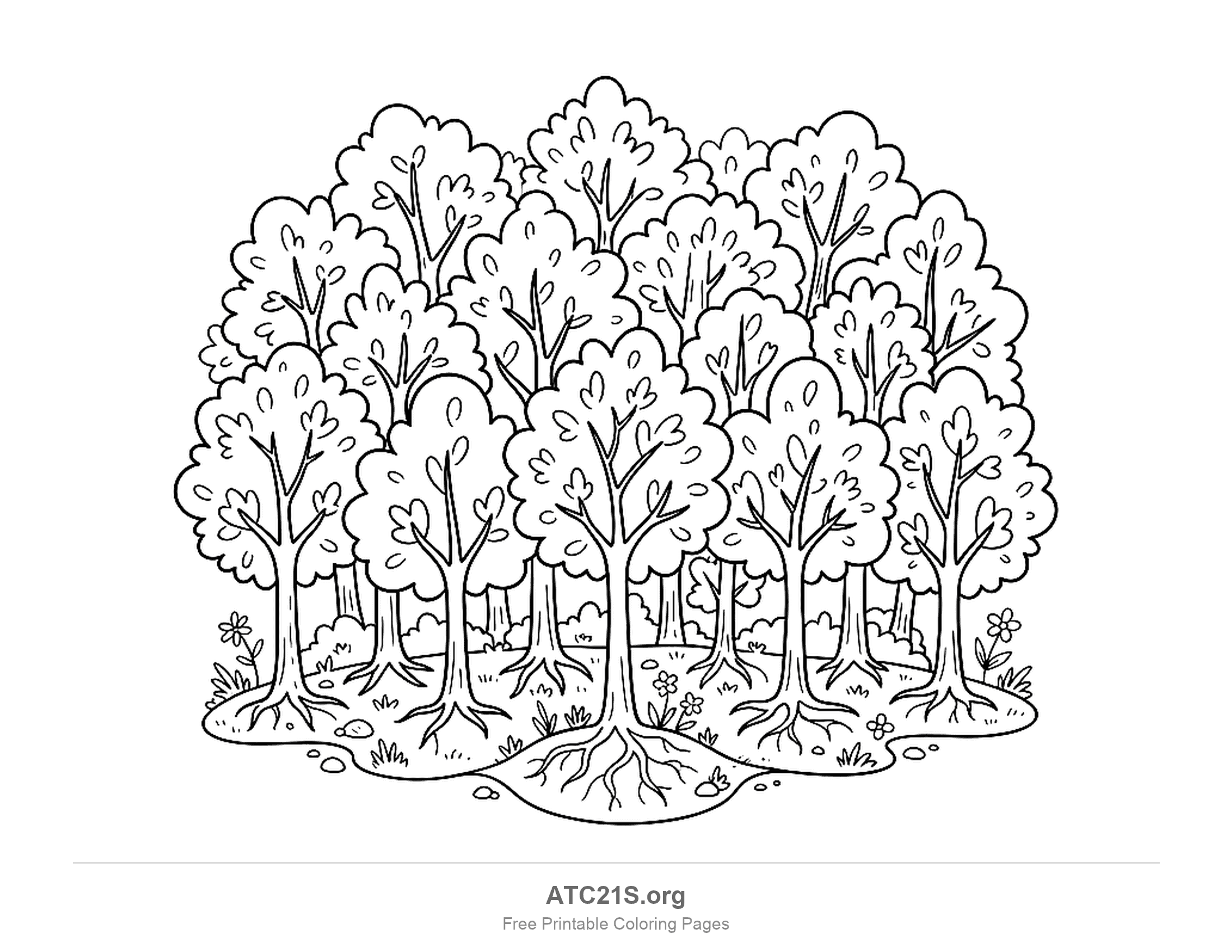
Seven free printable forest coloring pages, from a simple grove of round, leafy trees drawn in bold lines for little hands to a forest floor crowded with ferns and curling fiddleheads for older kids. Download the PNG or print straight from this page.
share:
pick a favourite
7 Forest designs to color
Tap any sheet for a closer look, then download or print it.
Forest Coloring Page - Birch Grove With Wildflowers
Forest Coloring Page - Smiling Trees And Mushrooms
Forest Coloring Page - Tall Pine Forest Trail
Forest Coloring Page - Hollow Log Among Ferns
Forest Coloring Page - Twisted Oak Woodland
Forest Coloring Page - Ferns And Fiddleheads Forest Floor
quick instructions
How to download and print
1. Pick your sheet
Preview any design below and choose the one you like best.
2. Print or download
Print straight from the page, or save the PNG to print later.
3. Color it in
Crayons, colored pencils or markers — plain paper works fine.
Every sheet is sized for landscape US Letter (11" x 8.5") at 200 DPI, so it fills the page without cropping. A4 works too — choose "fit to page" when printing.
while you color…
6 fun facts about the forest
Forests cover about a third of all the land on Earth.
A forest grows in layers: the forest floor at the bottom, the understory of bushes and young trees in the middle, and the canopy, the leafy roof made by the tallest treetops, at the top.
A young fern leaf comes up tightly coiled and slowly unrolls. It is called a fiddlehead because it looks like the curled top of a violin.
A mushroom is only a small part of a fungus. Most of it is a web of fine threads hidden in the soil and in rotting wood.
When a tree falls and starts to rot, moss, ferns and even new tree seedlings can grow right on top of it. Foresters call it a nurse log.
Birch bark is white and peels off in thin, papery layers. The dark dashes on it are tiny pores that let air into the trunk.
About the forest coloring page
A forest is a big stretch of land where trees grow close enough together that their tops meet overhead, with everything else that lives underneath them: bushes, ferns, moss, mushrooms, fallen logs and the animals that hide among them. Most children have walked through a wood, or at least a park with a clump of trees, and know the feeling of stepping out of the sun into the shade. A forest sheet gives them a whole place to fill rather than a single tree, and this set goes into seven very different ones: a little grove, a birch wood, a friendly wood full of toadstools, a pine forest, a fallen log in the ferns, a tangle of old oaks and a close-up of the forest floor.
Real forests are mostly green and brown: leaves in every shade from pale lime to dark bottle green, brown and grey bark, and a floor of brown leaves, dark soil and bright green moss. Birch trunks are white with black marks, pine forests are a deep blue-green all year, and in autumn a broadleaf wood turns yellow, orange, red and gold. That is a good starting point, and it is just as fine to ignore it: a purple pine forest, pink mushrooms or a rainbow oak wood are all welcome. What makes a picture read as a forest is lots of upright trunks standing side by side and a roof of leaves or needles joining them at the top. Every sheet here has trunks to colour first, which makes a simple plan for younger children: trunks, then treetops, then the ground.
The seven designs get steadily harder. First is a simple grove of about a dozen trees with round, cloud-shaped treetops, each with a forked trunk and spreading roots, standing on a grassy mound with a few flowers and pebbles, in bold outlines with big open spaces that suit younger children. Next is a birch wood: tall, slender white trunks marked with short dashes and dark eye-shaped knots, their branches arching overhead into a leafy roof, with a gap in the middle that shows the way through and ferns and wildflowers on the mounds in front. The third sheet is a friendly wood where three big trees have smiling faces on their trunks, surrounded by mushrooms of every size, some spotted, some striped and several with little smiling faces of their own, among ferns, flowers, twigs and fallen leaves. After that the drawings add more to do: a stand of tall, straight pines whose needles are drawn as tiny starbursts along drooping branches, with a trail winding between the trunks past mushrooms, ferns and pebbles; a hollow log lying across the forest floor with its open end facing us and a broken branch stub on top, ferns sprouting all around it, toadstools, oak and maple leaves and twigs on the ground, and tree trunks framing the scene; a wood of old, gnarled oaks whose twisting, rope-like trunks tangle into a canopy of leaves, with a path leading back into the distance; and finally a close-up of the forest floor, a thicket of tall fern fronds and tightly curled fiddleheads above a carpet of moss, clover and tiny flowers, for children who like a long, careful page.
These pages are a good way to show that a forest is built in layers, like a house with several floors. At the bottom is the forest floor, covered in fallen leaves, moss, mushrooms and rotting wood: the hollow log and the fern close-up are both down there. Above it is the understory, the ferns, bushes and young trees that grow in the shade, and at the top is the canopy, the leafy roof made where the tallest treetops meet, which is easy to see on the birch wood and the twisted oaks. Each layer has its own neighbours. A deer browses on the shoots of the understory, an owl nests in a hollow up in the trunks, and beetles, worms and fungi on the floor slowly turn fallen logs and leaves back into soil, which is why a forest never fills up with dead wood. The mushrooms on the third and fifth sheets are part of that clean-up crew. Older children can label the three layers on the birch sheet before they colour it, or colour each layer in its own shade of green.
Every sheet prints on landscape US Letter paper at 200 DPI, so the whole forest fills the page without being cut off. Plain copier paper is fine for crayons and colored pencils. If you are using markers or paint, slightly thicker card stock stops the colour bleeding through. It is worth doing on the hollow log, the twisted oaks and the fern floor, where the fern leaflets, the bark lines and the moss put the lines closest together.
In the classroom these pages pair well with a lesson on habitats, forest layers, decomposers, the seasons or the letter F. Hand out the round grove for a quick, cheerful page and save the fern floor for a quiet afternoon. A single tree from any of these sheets can be studied on its own on the tree coloring pages, which have their own pine and oak, and the oak and maple leaves scattered on the forest floor are drawn big on a page of leaves. For a wider view, the landscape coloring pages include an autumn path through the trees, and the pine forests that climb a mountainside until it is too cold for trees are on the mountain sheets. Forests that stay hot and wet all year look very different, and the jungle coloring pages swap the oaks and toadstools for hanging vines, orchids and giant lily pads. If the toadstools are the favourite part, a cluster of three smiling spotted ones has a sheet of its own among the mixed nature coloring pages, next to a rainbow, a sunflower and an ocean wave. The flowers, skies and the rest of the outdoors are in the nature coloring pages.
keep coloring