NatureLandscapes8 designsFree to print
print, color, learn
Free Landscape Coloring Pages
Eight free printable landscape coloring pages, from a barn on rolling hills drawn in a few clean lines for little hands to a thatched cottage in a meadow packed with wildflowers for older kids. Download the PNG or print straight from this page.
share:
pick a favourite
8 Landscape designs to color
Tap any sheet for a closer look, then download or print it.
Landscape Coloring Page - Bare Trees On Snowy Hills
Landscape Coloring Page - Tropical Island With Hammock
Landscape Coloring Page - Farm With Windmill And Cow
Landscape Coloring Page - Winding Forest Path
Landscape Coloring Page - Mountain Valley River
Landscape Coloring Page - Desert With Saguaros And Mesas
Landscape Coloring Page - Cottage In Wildflower Meadow
quick instructions
How to download and print
1. Pick your sheet
Preview any design below and choose the one you like best.
2. Print or download
Print straight from the page, or save the PNG to print later.
3. Color it in
Crayons, colored pencils or markers — plain paper works fine.
Every sheet is sized for landscape US Letter (11" x 8.5") at 200 DPI, so it fills the page without cropping. A4 works too — choose "fit to page" when printing.
while you color…
6 fun facts about the landscape
The line where the land or the sea seems to meet the sky is called the horizon. Standing on a beach, a grown-up can see about 5 kilometres (3 miles) out to sea before the curve of the Earth hides the water.
Faraway hills look paler and bluer than nearby ones because of all the air in between. Artists call painting them that way aerial perspective.
A river always flows downhill, starting on high ground such as hills or mountains and running towards a lake or the sea.
Leaves turn yellow and orange in autumn because the tree stops making green chlorophyll, which lets colours that were hidden in the leaf all along show through.
A saguaro cactus can grow taller than a three-storey house, but it often takes 50 years or more to grow its first arm.
About a third of all the land on Earth is desert, and that includes the icy deserts of Antarctica and the Arctic.
About the landscape coloring page
A landscape is a picture of a whole stretch of land: everything you can see in one view, from the grass at your feet to the hills, trees, water and buildings further off, with the sky over the top. Children already draw landscapes long before they know the word, with a strip of green along the bottom of the page, a house, a tree and a sun in the corner. A landscape sheet gives them a whole little world to fill instead of one object, and this set travels a long way: a farm on rolling hills, a winter wood, a tropical island, a windmill farm, an autumn forest path, a mountain valley, a desert and a cottage in a flower meadow.
Real landscapes change colour with the place and the season. Farmland and meadows are green and gold under a blue sky, a desert is sandy yellow with orange and red rock, a winter hillside is white and grey with dark bare branches, and an autumn forest turns yellow, orange, red and brown. That is a good place to start, and it is also fine to ignore it: purple hills, a pink river or a sky striped like a sunset are just as welcome. What makes a picture read as a landscape is a line where the land meets the sky, and things that get smaller the further away they are. Every sheet here has both, so children can colour the ground and the sky as two big areas first and then fill in everything standing between them.
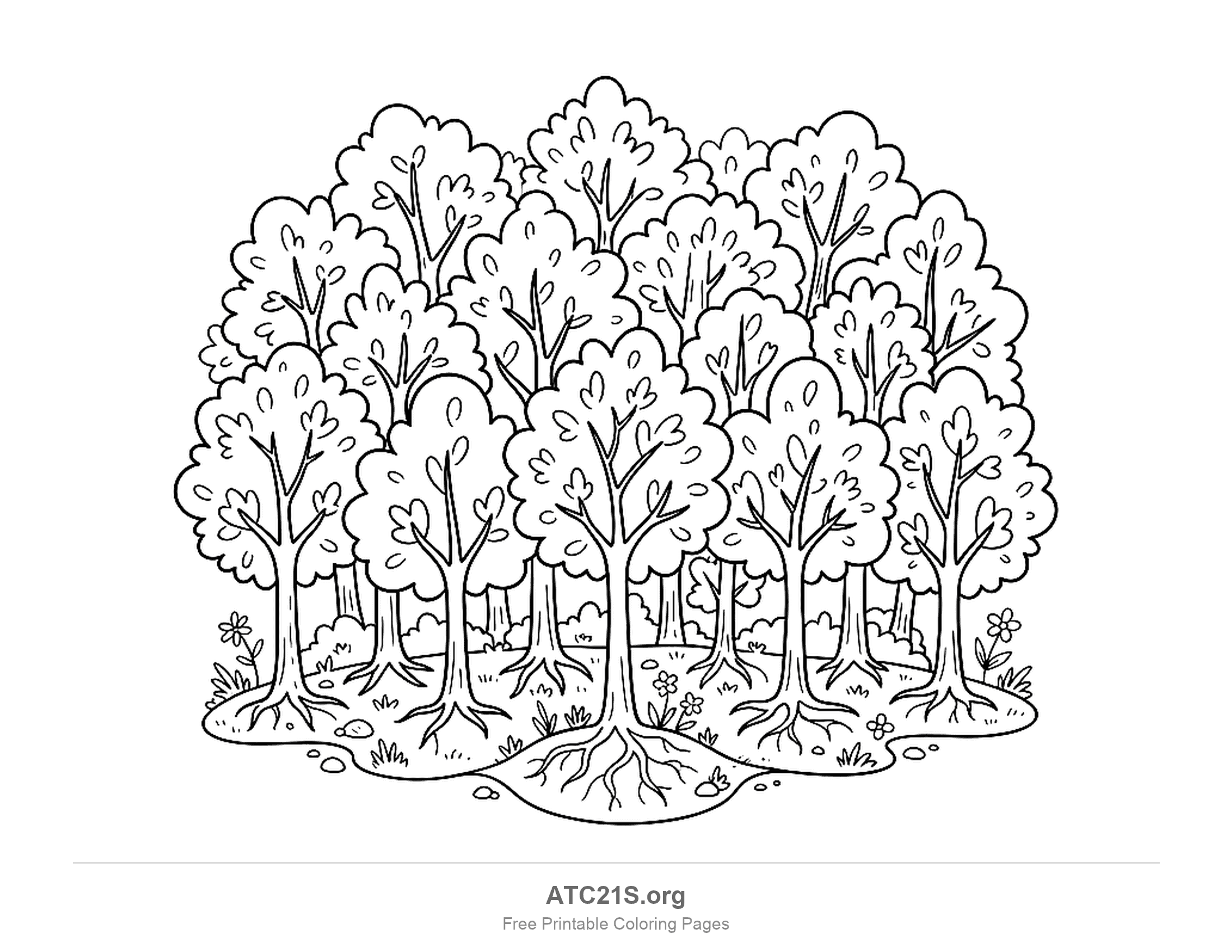
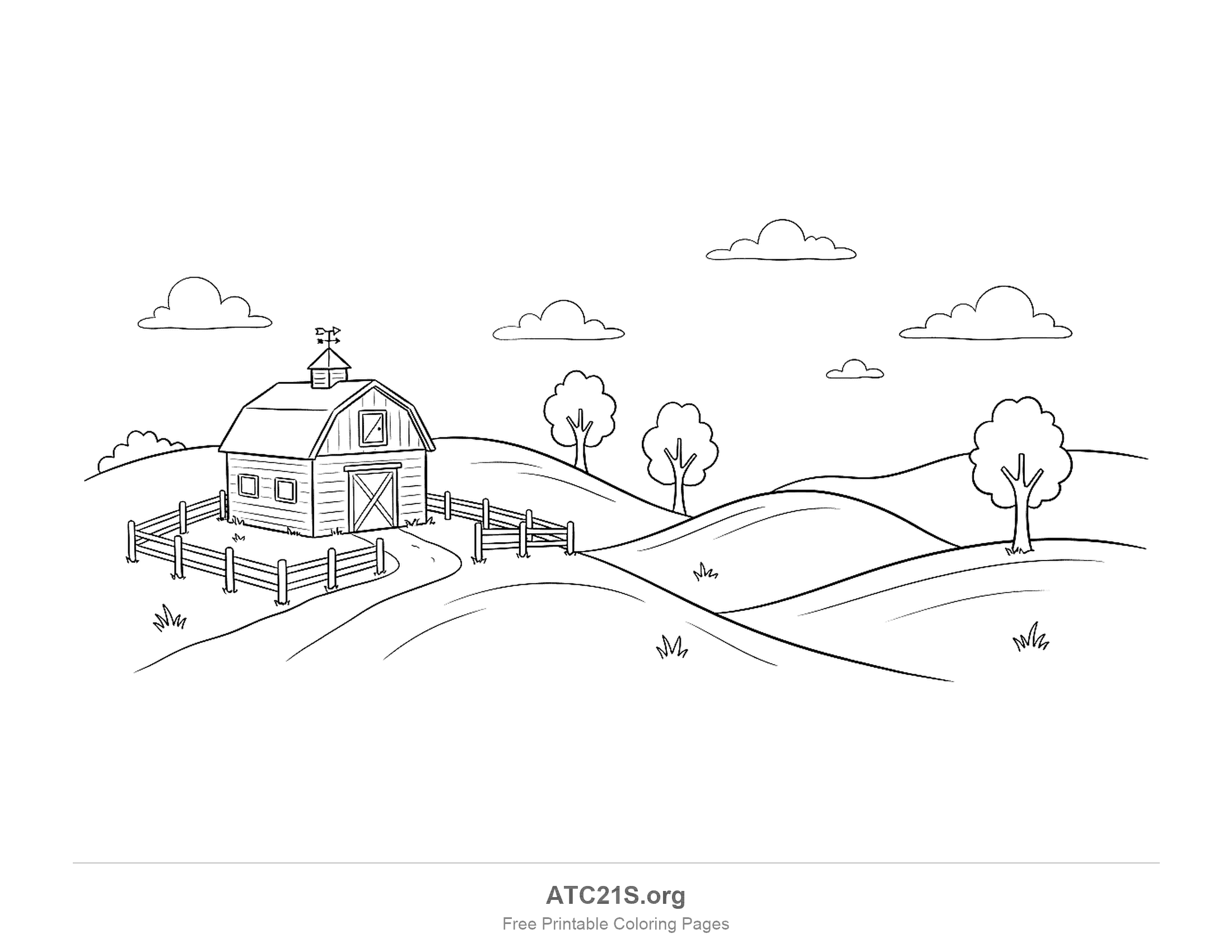
The eight designs get steadily harder. First is a barn on rolling hills: a barn with a big door, a little cupola and a weathervane on the roof, a wooden fence around its yard and a path curving down the hill, with three round-topped trees on the hills behind and a few puffy clouds in a wide, empty sky, so there are big open spaces that suit younger children. Next is a row of bare winter trees standing on soft, snowy hills, the big trees at the front and smaller ones further back, with long sweeping snowdrifts below them. The third sheet is a small sandy island in the sea, with six palm trees, a hammock strung between two of them, leafy bushes, seashells on the sand, curling waves all around and a sun with straight rays among a few clouds. The fourth is a farm with a windmill: four criss-cross sails on a wooden mill, a barn and a tall silo behind, fences curving across the fields, a tractor ploughing a far hill, a cow and a sheep grazing beside a pond, a flock of birds overhead and a dirt road winding to the front of the page. After that the drawings add more to do: a path winding from the bottom of the page into the distance between two rows of leafy trees, with fallen leaves scattered over the path and the grass; a mountain valley where a river curls back from the foreground, past rocks, reeds and a little island, between two pine forests towards a range of snow-capped peaks; a desert framed by two giant saguaro cacti, with smaller saguaros, a round barrel cactus, prickly pears, spiky agaves, a tall whippy ocotillo, boulders and pebbles in front of a row of flat-topped mesas; and finally a thatched stone cottage with smoke curling from its chimney, little-paned windows and a plank door, with a path winding through a meadow crowded with daisies, poppies, clover and lavender, for children who like a long, careful page.
These pages are a good way to show how artists make a flat sheet of paper look deep. Every landscape has three layers: the foreground, which is nearest to us and drawn biggest and lowest on the page; the middle ground; and the background, which is furthest away. Look at the mountain valley: the river is wide at the bottom of the page and narrows to a thin ribbon as it winds back, and the pines are tall at the front and tiny in the distance, even though real pines are all much the same size. The forest path does the same thing. The line at the very back, where the land or the sea seems to meet the sky, is called the horizon line, and the island sheet shows it most clearly, as one straight line of sea running behind the palm trees. A good trick for older children is to colour the background lighter and slightly bluer than the foreground, because faraway hills really do look paler through all the air between them and us, which is easy to see on the snowy peaks of the valley sheet and on the mountain coloring pages. Each scene can also be pulled apart into the single things it is made of: the trees on the hills, the forest path and the winter wood all grow up full size on the tree coloring pages, the bright sun over the island has a page of smiling suns to itself, and the puffy shapes drifting over the barn are on the cloud sheets. Children who would rather walk down that forest path than look along it can go in among the trees with a set of forest scenes, from a birch wood to a hollow log hidden in the ferns.
Every sheet prints on landscape US Letter paper at 200 DPI, so the whole scene fills the page without being cut off. Plain copier paper is fine for crayons and colored pencils. If you are using markers or paint, slightly thicker card stock stops the colour bleeding through. It is worth doing on the forest path, the desert and the cottage meadow, where the leaves in the treetops, the cactus spines and pebbles, and the crowd of wildflowers put the lines closest together.
In the classroom these pages pair well with a lesson on habitats, the seasons, maps and land use, farming, or the letter L. Put the winter wood beside the forest path and the island and ask children which season each one shows and how they can tell. The desert sheet leads straight to the cactus coloring pages, the island to the palm tree sheets and the shells lying on its sand to a page of seashells, and the grazing cow on the windmill farm to a printable cow. For children who want to draw a landscape of their own afterwards, the random drawing generator has a whole category of places to pick from. The flowers, trees and the whole sky are in the rest of the nature coloring pages.
keep coloring