NatureLandscapes8 designsFree to print
print, color, learn
Free Seashell Coloring Pages
Eight free printable seashell coloring pages, from a fan-shaped scallop drawn in bold, simple lines for little hands to a frilly, spiky murex shell for older kids. Download the PNG or print straight from this page.
share:
pick a favourite
8 Seashell designs to color
Tap any sheet for a closer look, then download or print it.
Seashell Coloring Page - Open Clam With Pearl
Seashell Coloring Page - Smooth Cowrie Shell
Seashell Coloring Page - Long Closed Mussel Shell
Seashell Coloring Page - Coiled Nautilus Shell
Seashell Coloring Page - Knobbly Conch On Its Side
Seashell Coloring Page - Tall Spiral Shell With Wavy Bands
Seashell Coloring Page - Frilly Spiked Murex Shell
quick instructions
How to download and print
1. Pick your sheet
Preview any design below and choose the one you like best.
2. Print or download
Print straight from the page, or save the PNG to print later.
3. Color it in
Crayons, colored pencils or markers — plain paper works fine.
Every sheet is sized for landscape US Letter (11" x 8.5") at 200 DPI, so it fills the page without cropping. A4 works too — choose "fit to page" when printing.
while you color…
6 fun facts about the seashell
A seashell is built by the animal that lives in it, from calcium carbonate it takes out of the sea water. Chalk is made of the same stuff.
A scallop can have up to 200 tiny eyes in a row along the edge of its shell.
A pearl forms when a bit of grit or a tiny parasite gets inside an oyster, clam or mussel, and the animal slowly coats it in smooth, shiny layers of shell.
Small cowrie shells were used as money for hundreds of years in parts of Africa and Asia.
A nautilus lives in the newest, biggest chamber of its coiled shell and uses the older, empty chambers like a float to rise and sink in the sea.
The rushing sound you hear when you hold a shell to your ear is not the sea. It is the sounds around you echoing inside the curved shell.
About the seashell coloring page
A seashell is the hard outer home of a soft-bodied sea animal called a mollusc. Snails, clams, scallops, mussels and the nautilus all build their own shells, and when the animal dies the empty shell is rolled about by the waves until it washes up on the beach. Almost every child who has been to the seaside has filled a bucket or a pocket with them, lined them up on a windowsill, or held one to an ear to listen for the sea. A shell is a small, solid thing with a clear outline, which makes it a satisfying subject to colour, and this set gathers eight different kinds: a scallop, an open clam with a pearl, a cowrie, a mussel, a nautilus, a conch, a tall spiral shell and a frilly murex.
Real shells come in more colours than people expect. Scallops can be orange, pink, red, purple or white, often in stripes; a cowrie is glossy and usually brown or cream with darker spots; a mussel is blue-black on the outside and pearly purple and blue on the inside; a nautilus is creamy white with reddish-brown stripes; and the queen conch is creamy tan outside with a bright pink lip around its opening. That is a good place to start, and it is just as fine to ignore it: a rainbow scallop or a green-and-gold conch is welcome. Two shapes make a shell recognisable at a glance. Clams, scallops and mussels are made of two matching halves joined by a hinge, with ribs or growth lines fanning out from it, while snail shells are one piece coiled into a spiral that ends in a point. Every sheet here shows one or the other clearly, so children can colour the big outline first and the ribs or bands after.
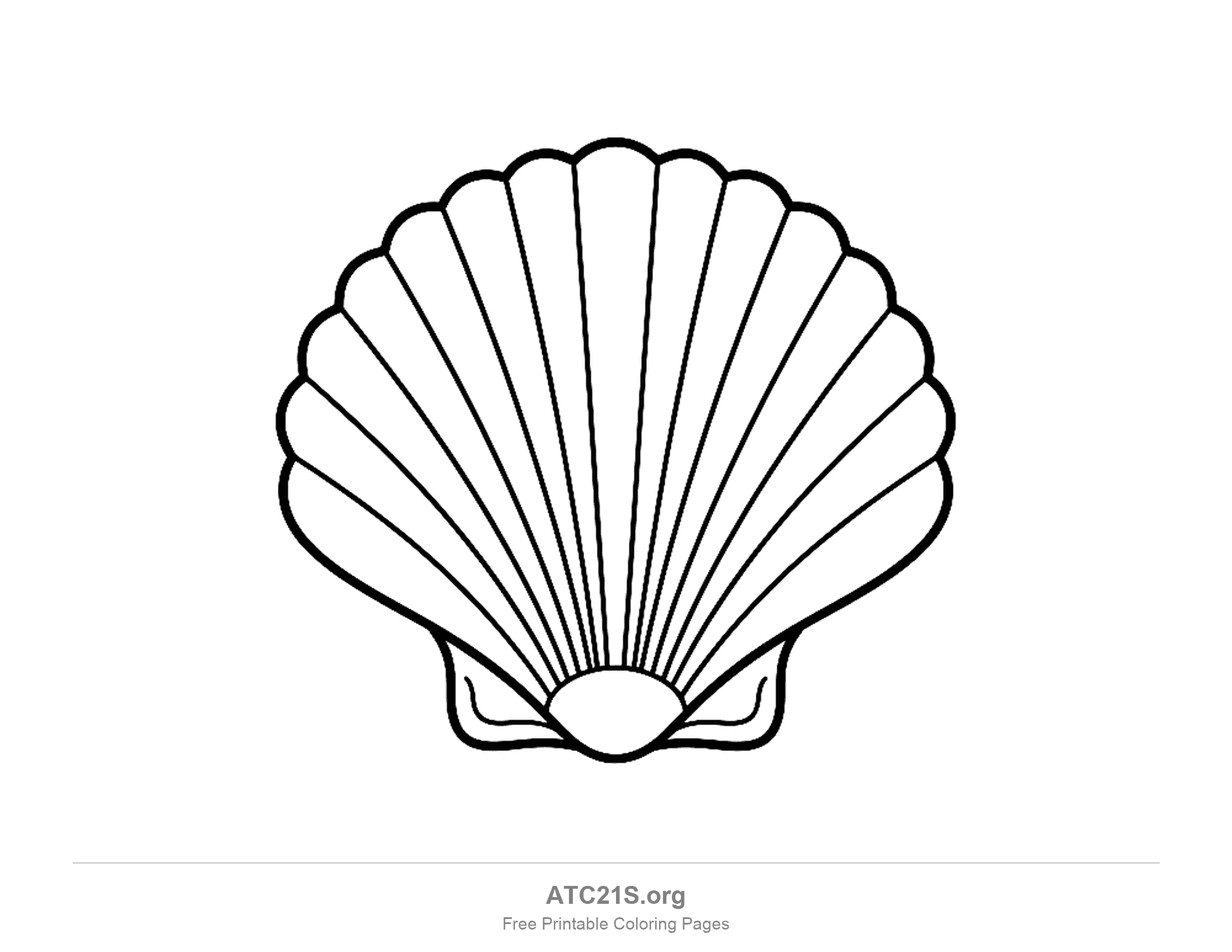
The eight designs get steadily harder. First is a scallop shell, a fan with a scalloped top edge and about a dozen ribs spreading from a small hinge at the bottom, with a little wing sticking out on each side of the hinge, all in thick outlines with wide spaces for younger children. Next is a clam lying open, its ribbed, scalloped top half raised like a lid over a shallow bowl with a wavy rim, and a big round pearl sitting in the middle. The third sheet is a cowrie seen from the side: a smooth, domed back with a single curved shine line and a long, narrow opening underneath, lined with little teeth on both lips. After that the drawings add more to do: a long mussel lying on a slant with its two halves closed tight along one seam, fine growth lines curving away from its pointed hinge end; a nautilus, a big round coiled shell whose curved inner walls are drawn showing, as if it had been cut in half, so the chambers shrink in a spiral towards the tiny centre; a conch lying on its side, its ringed point on the left, a row of knobs along its shoulder and a wide, wavy lip flaring open on the right; a tall spiral shell standing on its tip, with wavy bands around every turn of the spiral, knobs on its shoulder and a long opening down one side; and finally a murex covered in frilly, ruffled ridges and spikes, with a small ringed point at the top and a round opening with a crinkled lip at the bottom, for children who like a long, careful page.
The best question to ask about each sheet is which animal made it. The scallop, the clam and the mussel are bivalves, which means "two shells": the animal lives between the two halves and opens them to feed, and a scallop can even swim by clapping its halves together. The cowrie, the conch, the tall spiral shell and the murex were all made by sea snails, which carry a single coiled shell on their backs like a garden snail. The nautilus is the surprise: it is a cousin of the octopus and squid, with dozens of tentacles, and it lives in the biggest, newest chamber of its shell. Every one of these animals builds its shell from minerals in the sea water and adds to the open edge as it grows, so the pointed tip of a spiral is the oldest part, the shell the snail had when it was tiny. Sorting the eight sheets into two halves, one spiral and the nautilus makes a quick science game. And yes, children can test whether they can hear the sea: the rushing sound inside a big shell like the conch is really the noise of the room around them bouncing about inside its curved hollow, and a cup held over the ear does much the same thing. On a real beach, it is worth teaching children to check that a shell is empty before they take it, and to put it back gently if something is still living inside.
Every sheet prints on landscape US Letter paper at 200 DPI, so the shell fills the page without being cut off. Plain copier paper is fine for crayons and colored pencils. If you are using markers or paint, slightly thicker card stock stops the colour bleeding through. It is worth doing on the conch, the tall spiral shell and the murex, where the knobs, the wavy bands and the ruffled frills put the lines closest together.
In the classroom these pages pair well with a lesson on beaches and rock pools, ocean habitats, sorting and classifying living things, spirals in maths, or the letter S. Hand out the scallop for a quick, cheerful page and save the murex for a quiet afternoon. To turn a shell into a whole day at the beach, the tropical island on the landscape coloring pages has shells scattered on its sand under a row of palms, the palm tree sheets supply the shade, and a smiling sun can go in the sky. The curling ocean wave that washes shells up the beach is one of the designs on the mixed nature pages. Empty sea snail shells also make second-hand homes for hermit crabs, two of which share a spiral shell on the crab coloring pages, and the nautilus's eight-armed cousin has a set of octopus pages of its own. The flowers, skies and the rest of the outdoors are in the nature coloring pages.
keep coloring