AnimalsJungle8 designsFree to print
print, color, learn
Free Monkey Coloring Pages
Eight free printable monkey coloring pages, from a curled-up sleeping monkey for little hands to a proud standing monkey with furry arms for older kids. Download the PNG or print straight from this page.
share:
pick a favourite
8 Monkey designs to color
Tap any sheet for a closer look, then download or print it.
Monkey Coloring Page - Hanging Upside Down
Monkey Coloring Page - Sitting Waving
Monkey Coloring Page - Jumping Arms Up
Monkey Coloring Page - Scratching Head
Monkey Coloring Page - Giggling Hands Over Mouth
Monkey Coloring Page - Baby Sitting
Monkey Coloring Page - Proud Hands On Hips
quick instructions
How to download and print
1. Pick your sheet
Preview any design below and choose the one you like best.
2. Print or download
Print straight from the page, or save the PNG to print later.
3. Color it in
Crayons, colored pencils or markers — plain paper works fine.
Every sheet is sized for landscape US Letter (11" x 8.5") at 200 DPI, so it fills the page without cropping. A4 works too — choose "fit to page" when printing.
while you color…
6 fun facts about the monkey
Some South American monkeys have a prehensile tail that works like a fifth hand and can hold a branch.
Howler monkeys are among the loudest land animals — their call can be heard up to 3 miles (5 km) away.
Most monkeys live in groups called troops, which can be a few animals or more than a hundred.
A baby monkey clings to its mother's fur from the day it is born and rides on her back as it grows.
Capuchin monkeys use rocks as tools to crack open nuts, and they teach the trick to their young.
Monkeys have tails; apes such as chimpanzees, gorillas and orangutans do not.
About the monkey coloring page
Monkeys live in the tropical forests of Africa, Asia, and Central and South America. They are primates, the same big family as apes and humans, and children usually pick them out by the long tail, the grasping hands and the very human-looking face. Most species live in groups called troops, spend a lot of time in the trees, and use those tails for balance — and, in some South American monkeys, as a fifth hand that can grab a branch.
Colour is more open than it first seems. Brown, grey, black and golden-tan are all real monkey colours, and the face, chest and inner ears are often paler or pink. Point out the pale face patch on several of these sheets and leave it lighter than the rest of the body — that one trick makes even a quick crayon job look finished. A purple or rainbow monkey is absolutely allowed; nothing here is wrong.
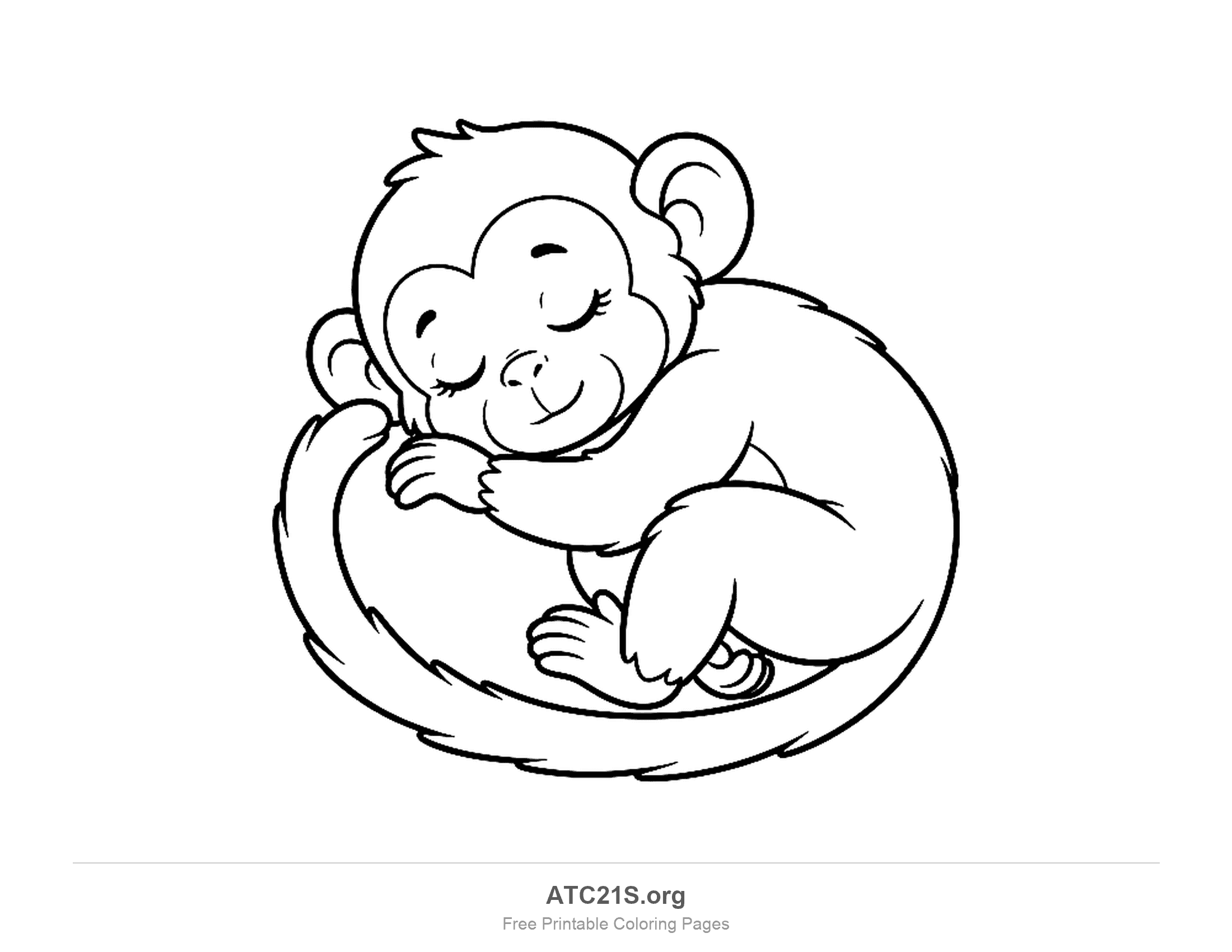
The eight designs run from easiest to hardest. The sleeping monkey curled around its own tail comes first — thick outlines, a compact circle and almost no small interior shapes, right for toddlers. Then a cute monkey hanging upside down from a spiral tail, one sitting and waving, and one leaping with both arms in the air, all still bold and cartoonish. After that the detail climbs: a curious monkey scratching its head, a giggling one covering its mouth, a baby hugging its knees with fur strokes along its back, and finally a proud standing monkey with hands on its hips and furry arms for children who want a longer project.
One small thing worth noticing on that last sheet: it has no tail. Real monkeys almost always have one; apes such as chimpanzees do not. Children who have just coloured both a hanging monkey and this standing one usually love being the person at the table who can tell them apart.
Every sheet prints on landscape US Letter paper at 200 DPI, so the monkey fills the page without being cut off. Plain copier paper is fine for crayons and colored pencils. Use slightly thicker card stock for markers or paint on the last two designs, where the fur lines sit close together and can bleed shut on flimsy paper.
In the classroom these pages pair well with a lesson on jungle animals, on primates, on tails and what they are for, or on the letter M. The sleeping monkey is a calm wind-down sheet; the jumping and waving ones make a cheerful display; the baby and the proud standing monkey can fill a quiet afternoon. Print a few different designs and let each child pick the one that matches their patience that day. The gorilla pages show the ape without a tail, the sloth the slowest neighbour in the same trees, and the zoo page puts four more monkeys on a rope playground. The animal pages cover the rest of the jungle.