NatureSky & Weather8 designsFree to print
print, color, learn
Free Sun Coloring Pages
Eight free printable sun coloring pages, from a sleepy smiling sun with one ring of wavy rays in thick outlines for little hands to a sun whose rays are filled with swirls and curls for older kids. Download the PNG or print straight from this page.
share:
pick a favourite
8 Sun designs to color
Tap any sheet for a closer look, then download or print it.
Sun Coloring Page - Laughing Face Pointed Rays
Sun Coloring Page - Smiling Sun Rounded Petal Rays
Sun Coloring Page - Eight Rays With Hearts
Sun Coloring Page - Starburst Rays Flame Sparks
Sun Coloring Page - Winking Face Wavy Rays
Sun Coloring Page - Double Zigzag Rays
Sun Coloring Page - Detailed Swirl Pattern Rays
quick instructions
How to download and print
1. Pick your sheet
Preview any design below and choose the one you like best.
2. Print or download
Print straight from the page, or save the PNG to print later.
3. Color it in
Crayons, colored pencils or markers — plain paper works fine.
Every sheet is sized for landscape US Letter (11" x 8.5") at 200 DPI, so it fills the page without cropping. A4 works too — choose "fit to page" when printing.
while you color…
6 fun facts about the sun
The sun is a star. It looks much bigger and brighter than the others only because it is so much closer to us.
Sunlight takes about 8 minutes to travel the 150 million kilometres (93 million miles) from the sun to Earth.
More than a million Earths could fit inside the sun.
The surface of the sun is about 5,500 °C (10,000 °F), many times hotter than an oven.
The sun does not really move across the sky. The Earth spins, which makes the sun seem to rise in the east and set in the west.
Sunday is named after the sun. In Old English it was called Sunnandæg, which means the sun's day.
About the sun coloring page
The sun is the first thing many children draw when they are given a crayon and a blank sheet: a yellow circle in the top corner with lines sticking out of it, often with a smiling face. It is in their picture books, on weather charts and on summer T-shirts, and it is the reason for daytime, warm weather, long evenings in the park and the shadow that follows them across the playground. That makes a sun page an easy one to hand over at almost any age. Every sheet here is a cheerful sun with a face, from a sleepy one with its eyes closed to a laughing one, a winking one and one with every ray filled with patterns.
Seen from the ground, the sun looks yellow at midday and turns orange, pink and red as it sinks at sunset, which is why most children reach for yellow, orange and red, perhaps with a blue sky coloured in behind. That is a perfectly good way to color these sheets. It is also fine to ignore it. A purple sun with green rays, or rays that go through every colour of the rainbow, is just as welcome, and the rosy cheeks on most of the faces are a nice spot for pink. The two shapes that make a picture read as the sun are a big circle and a ring of rays spreading out from it on every side, and all eight designs are built from exactly those two things.
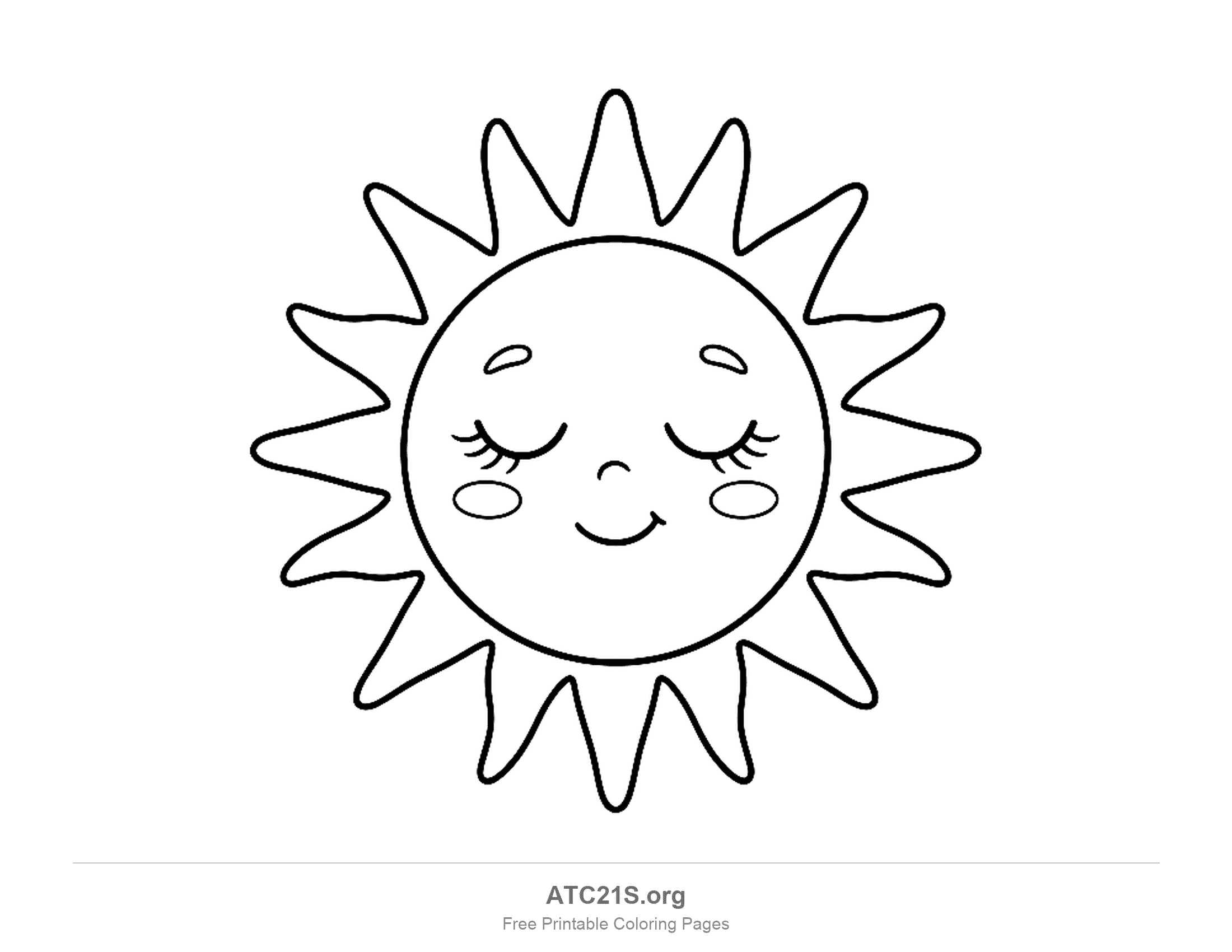
The eight designs get steadily harder. First is a sleepy sun with its eyes closed, long lashes, oval rosy cheeks and a small smile, surrounded by a single wavy outline of pointed rays, so there are only two big spaces to fill and it suits toddlers still learning to stay inside the lines. Then a laughing sun with its eyes squeezed shut and a wide-open mouth, ringed by separate teardrop-shaped rays that can each be a different colour. The third sheet is a smiling sun with big round eyes inside a ring of rounded, petal-shaped rays, which looks almost like a daisy. The fourth has eight long, straight, pointed rays like the points of a star, with eight small hearts floating in the gaps between them. After that the drawings add more to do: a starburst sun whose rays form one sharp zigzag ring, with little flame-shaped sparks flying off around the edge; a winking sun with one eye shut, whose long straight rays take turns with wavy, flame-like ones, and small leaf-shaped drops dotted between them; a sun with two zigzag rings, one inside the other, so every ray becomes a narrow band to colour; and finally a sun with big shiny eyes, a nose and rosy cheeks, its long pointed rays each filled with swirls and curls and loose curly tendrils floating between them, for children who like a long, careful page.
What the sun actually is makes the detail worth pausing on. It is a star, the same kind of thing as the stars children see at night, but it is so much closer to us that it looks like a big bright circle instead of a twinkling dot. It is a huge ball of very hot gas, so big that more than a million Earths could fit inside it, and its light takes about eight minutes to reach us. The sun also does not really travel across the sky. The Earth spins once a day, and as it turns, the sun seems to rise in the east and set in the west. A stick pushed into the ground shows this nicely: mark the end of its shadow in the morning, at lunchtime and in the afternoon, and children can watch the shadow swing round and shrink at midday. Young sunflowers follow the sun in the same way, turning their heads from east to west through the day, and the sunflower coloring pages have a tall plant that is perfect for talking about it. One rule goes with all of this: never look straight at the sun, not even with sunglasses on, because it can hurt your eyes.
Every sheet prints on landscape US Letter paper at 200 DPI, so the sun fills the page without being cut off. Plain copier paper is fine for crayons and colored pencils. If you are using markers or paint, slightly thicker card stock stops the colour bleeding through. It is worth doing on the winking-sun, double-zigzag and swirl-pattern sheets, where the little drops, the nested zigzags and the curls inside each ray put the lines closest together.
In the classroom these pages pair well with a lesson on day and night, the seasons, the weather, the solar system, staying safe in the sun, or the letter S. For the night half of a day-and-night lesson, the moon sheets make a matching set of friendly faces, and a printable globe between the two shows which half of the planet is facing the sun. The days of the week fit too, because Sunday is named after the sun, and the Sunday coloring page makes a good partner sheet. Sunshine and a passing shower together make a rainbow, so the rainbow sheets belong beside these on a weather display. The sun's warmth also lifts water out of the sea and puddles as invisible vapour, which cools high up into the tiny droplets that make a cloud, so the cloud sheets complete the weather chart, and a full set of weather sheets puts the sun on one page beside rain, snow, a thunderstorm and a windy day. Plants need sunlight to live: a leaf catches the light and uses it to turn water and air into food, which the leaf coloring pages explain, while a cactus is built to survive under a fierce desert sun, and the printable cacti show how. The petal-ray sheet sits nicely beside the daisy sheets for a game of spot the difference. Animals use the sun as well: a crocodile lies on a riverbank in the sunshine to warm its body up, which the crocodile coloring pages show. The color-by-number math generator makes a practice sheet to go with it, and the flowers, trees and landscapes are in the rest of the nature coloring pages.