NatureSky & Weather8 designsFree to print
print, color, learn
Free Cloud Coloring Pages
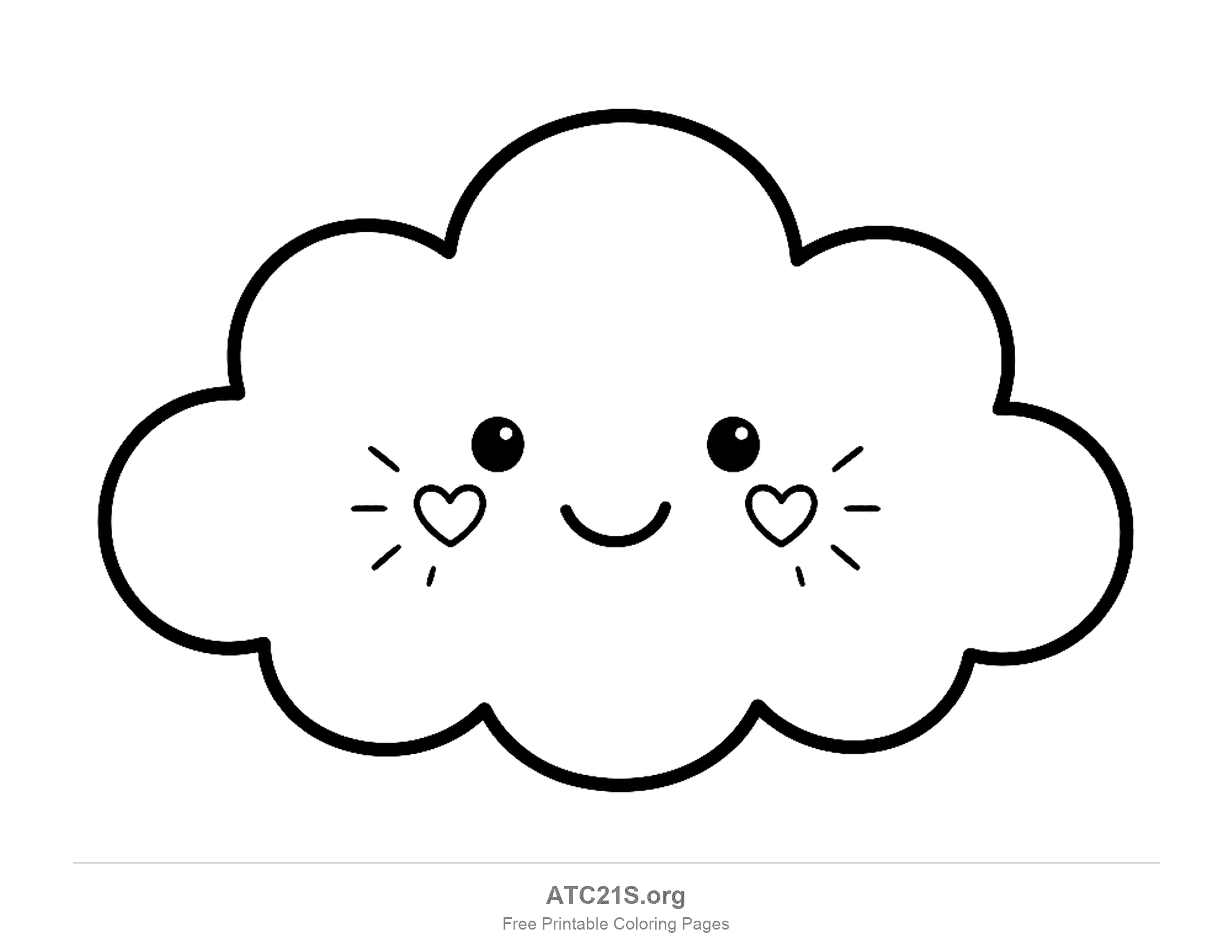
Eight free printable cloud coloring pages, from a smiling cloud with heart-shaped cheeks in thick outlines for little hands to a big layered cumulus cloud built from overlapping puffs for older kids. Download the PNG or print straight from this page.
share:
pick a favourite
8 Cloud designs to color
Tap any sheet for a closer look, then download or print it.
Cloud Coloring Page - Sleepy Closed Eyes
Cloud Coloring Page - Big Eyes Happy Grin
Cloud Coloring Page - Rain Cloud With Raindrops
Cloud Coloring Page - Smiling With Stars
Cloud Coloring Page - Waving Hello
Cloud Coloring Page - Polka Dot Party Hat
Cloud Coloring Page - Layered Cumulus Puffs
quick instructions
How to download and print
1. Pick your sheet
Preview any design below and choose the one you like best.
2. Print or download
Print straight from the page, or save the PNG to print later.
3. Color it in
Crayons, colored pencils or markers — plain paper works fine.
Every sheet is sized for landscape US Letter (11" x 8.5") at 200 DPI, so it fills the page without cropping. A4 works too — choose "fit to page" when printing.
while you color…
6 fun facts about the cloud
A cloud is made of billions of tiny water droplets or ice crystals, each far too small to see on its own.
It takes about a million cloud droplets joining together to make one raindrop heavy enough to fall.
A puffy cumulus cloud can weigh about 500 tonnes, as much as 100 elephants, but its droplets are so tiny and spread out that rising air holds them up.
Fog is simply a cloud that has formed down at ground level.
Cloud names come from Latin: cumulus means heap, stratus means layer, and cirrus means a curl of hair.
Clouds look white because they scatter all the colours of sunlight, and a thick rain cloud looks grey because less light gets through it.
About the cloud coloring page
Clouds are the part of the sky that is always changing. Children lie on the grass and find dragons and rabbits in them, watch them turn grey before a storm, and draw them as a bumpy white shape next to the sun on almost every picture of a sunny day. A cloud is also one of the easiest outlines to colour, because it is one big rounded shape with lots of room inside, which makes it a good first page for toddlers and a calm one for older children. Seven of the sheets here are friendly cartoon clouds with faces, and the last is a real-looking heap of puffs with no face at all.
Real clouds are white on a bright day, grey when they are thick with rain, and pink, orange and gold at sunrise and sunset, so a child can pick any of those and be right. A blue sky coloured in around the cloud makes the white stand out, and on these sheets the cheeks, the raindrops, the stars and the party hat are all good places for bright colour. A rainbow cloud, a purple cloud or a cloud in a child's favourite colour is just as welcome. What makes a shape read as a cloud is a row of round bumps along the top and a flatter, scalloped edge along the bottom, and every design here is built from those puffs.
The eight designs get steadily harder. First is a smiling cloud in the thickest outlines of the set, with two shiny round eyes, a small smile and heart-shaped cheeks with little blush lines around them, so there is one big space to fill and it suits toddlers still learning to stay inside the lines. Then a sleepy cloud with its eyes closed in curved, lashed arcs, a gentle smile and two dotted-line circles for rosy cheeks. The third sheet is a cloud with big round eyes, raised eyebrows and a wide open-mouthed grin, its bottom edge split into separate rounded lobes. The fourth is a smiling rain cloud with nine teardrop-shaped raindrops falling below it in staggered rows. After that the drawings add more to do: a happy cloud with oval cheeks and little shine lines on its puffs, surrounded by eight small stars; a laughing cloud reaching out one arm to wave a cartoon hand; a smiling cloud wearing a tilted cone-shaped party hat covered in polka dots, with a fluffy pom-pom on top; and finally a big cumulus cloud with no face, made of more than a dozen overlapping puffs, each outlined as its own rounded shape, for children who like a long, careful page.
Where clouds come from is the lesson that goes with these pages, and it is the middle of the water cycle. The sun warms the sea, lakes and puddles, and some of the water evaporates into an invisible gas called water vapour. Warm air carries it upwards, and as the air rises it cools, until the vapour turns back into tiny droplets of water, or ice crystals if it is cold enough, gathered around specks of dust. Billions of those droplets together make a cloud. When the droplets bump into each other and join up, they grow too heavy to stay up and fall as rain or snow, which runs back into rivers and the sea for the whole thing to start again. The rain-cloud sheet shows that last step, and laying it beside the sun coloring pages makes a simple two-picture water cycle. For the rain itself, the rainy day coloring pages have a waving raindrop, a cloud in a rain hat and a girl in a hooded raincoat, and for the six-armed ice crystals that fall when the cloud is cold enough, there are printable snowflakes. Clouds also have names, given to them more than two hundred years ago by an English weather watcher called Luke Howard: cumulus for the puffy heaps like the one on the last sheet (a cumulus that keeps on growing can tower into a thunderstorm, and the strongest of those are where the spinning funnels on the tornado sheets come from), stratus for flat grey layers, and cirrus for thin wisps high in the sky. Children can go outside, look up and decide which kind they can see. Not every cloud is made of water, though: the grey plume above an erupting volcano is an ash cloud of tiny bits of rock and glass, and the volcano sheets show three of them billowing out of one crater.
Every sheet prints on landscape US Letter paper at 200 DPI, so the cloud fills the page without being cut off. Plain copier paper is fine for crayons and colored pencils. If you are using markers or paint, slightly thicker card stock stops the colour bleeding through. It is worth doing on the star, party-hat and layered cumulus sheets, where the small stars, the polka dots and the narrow gaps between overlapping puffs put the lines closest together.
In the classroom these pages pair well with a lesson on weather, the water cycle, the seasons, a weather chart for the classroom wall, or the letter C. Clouds are the starting point for most of the weather set too, where they rain, snow, flash lightning and puff out a gust of wind, so the two make a natural follow-on. Clouds and sunshine together are what make a rainbow, and several of the rainbow coloring pages already rest their arches on puffy clouds, so the two sets belong side by side on a weather display. The cloud surrounded by stars fits a night sky with the printable moon and a few star sheets, and a cloudy night is a good moment to explain why the moon sometimes disappears. Big birds use the same rising warm air that builds clouds: eagles circle upwards on columns of warm air called thermals, and a puffy cumulus often sits right at the top of one, which makes the eagle coloring pages a good partner sheet. The word cloud generator can turn the new weather words into a poster to go with them, and the flowers, trees and the rest of the sky are in the nature coloring pages.