NaturePlants & Trees8 designsFree to print
print, color, learn
Free Cactus Coloring Pages
Eight free printable cactus coloring pages, from a smiling round cactus in a flowerpot in thick outlines for little hands to a barrel cactus crowned with big open blooms for older kids. Download the PNG or print straight from this page.
share:
pick a favourite
8 Cactus designs to color
Tap any sheet for a closer look, then download or print it.
Cactus Coloring Page - Happy Cactus With Flower
Cactus Coloring Page - Simple Saguaro On Sand
Cactus Coloring Page - Four Armed Cactus On Hill
Cactus Coloring Page - Ribbed Saguaro Rows Of Spines
Cactus Coloring Page - Prickly Pear Flowers And Fruit
Cactus Coloring Page - Potted Barrel Cactus Flower Crown
Cactus Coloring Page - Detailed Blooming Barrel Cactus
quick instructions
How to download and print
1. Pick your sheet
Preview any design below and choose the one you like best.
2. Print or download
Print straight from the page, or save the PNG to print later.
3. Color it in
Crayons, colored pencils or markers — plain paper works fine.
Every sheet is sized for landscape US Letter (11" x 8.5") at 200 DPI, so it fills the page without cropping. A4 works too — choose "fit to page" when printing.
while you color…
6 fun facts about the cactus
Cactus spines are leaves that have changed shape. The thick green stem makes the plant's food instead.
A saguaro cactus can grow taller than a two-storey house and live for more than 150 years.
A saguaro can be 50 years old or more before it grows its first arm.
After a big rain, a saguaro's pleated stem swells up with water, and a large one can weigh as much as a car.
Tiny elf owls, about the size of a sparrow, make their nests in old woodpecker holes in saguaro cacti.
Prickly pear fruit is sweet and juicy, and in Mexico the flat pads are cooked and eaten as a vegetable called nopales.
About the cactus coloring page
A cactus is the one plant every child can draw from memory: a green column with two arms bent upward, standing in the sand under a hot sun. Children see them in cartoons and westerns, in little pots on windowsills and shop counters, and on lunchboxes, T-shirts and birthday cards, and the fact that you should not touch one makes them even more interesting. This page has eight of them, from cheerful cartoon cacti with faces to the tall saguaro of the desert, a prickly pear with flat pads and fruit, and round barrel cacti in flower.
Most real cacti are green, from a bright grass green to a dusty blue-green or grey-green, with spines that can be white, cream, yellow, brown or reddish. The flowers are where the colour really shows: cactus blooms come in hot pink, magenta, yellow, orange, red and white, and prickly pear fruit ripens to a deep red-purple. That is a perfectly good way to color these sheets. It is also fine to ignore it. A purple cactus, a striped one or one in a polka-dot pot is just as welcome, and the pots on the first and seventh sheets are a blank space for patterns. The shapes worth pointing out are the ones that make a cactus look like a cactus: a thick, fat stem with ridges running from top to bottom, and little clusters of spines dotted along those ridges.
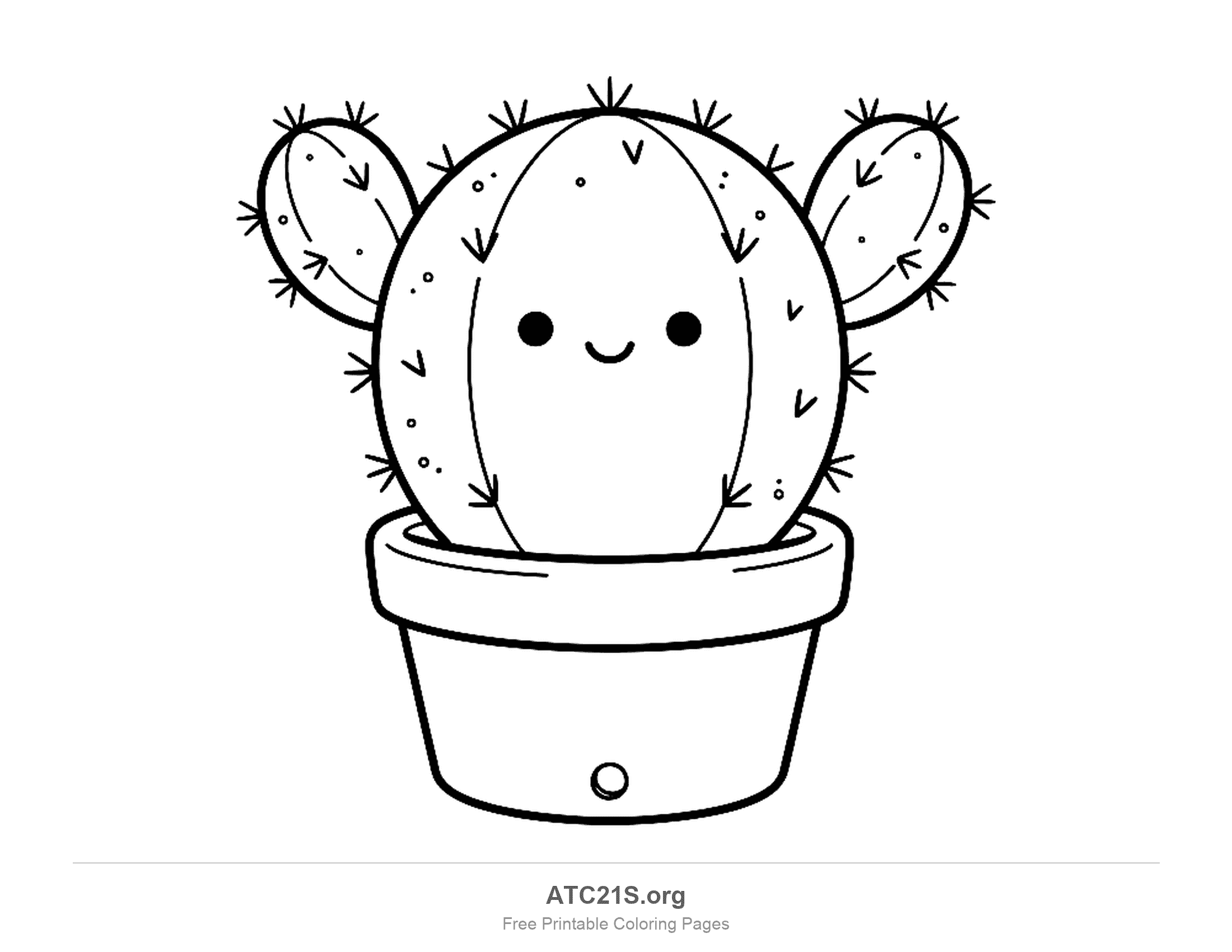
The eight designs get steadily harder. First is a round cactus with dot eyes and a small smile, two oval pads sticking up on either side like ears and little tufts of spines, sitting in a flowerpot with a wide rim and a drainage hole, all in the thickest outlines of the set for toddlers still learning to stay inside the lines. Then a tall, laughing cactus with closed happy eyes, round rosy cheeks, two short arms raised and a five-petal flower with two leaves on top of its head. The third sheet is a plain saguaro with two upturned arms, a few lines for its ribs and small spines along the edges, standing on a low line of sand. The fourth is a smiling cactus waving four arms, with spines along its stripes, on a rounded hill with tufts of grass and a few pebbles. After that the drawings add more to do: a tall saguaro whose trunk and arms are lined with narrow ribs and neat rows of spines down every one; a prickly pear built from oval pads stacked one on another, each dotted with spine clusters, with small round fruits, a bud and three open flowers along the top; a round ribbed cactus in a pot, every rib covered in star-shaped spine clusters, with a crown of three flowers on top; and finally a big barrel cactus with rows of star-shaped spines, topped by a bunch of large open blooms with every stamen drawn in, for children who like a long, careful page.
How a cactus survives in the desert is the part worth pausing on. It may not rain there for months, so a cactus stores water in its thick, spongy stem, and the ridges on a saguaro fold out like an accordion to make room when it fills up after a storm. A cactus has no ordinary leaves to lose water through. Its spines are leaves that have changed shape over millions of years: they protect the stem from thirsty animals, shade it from the sun and trap a thin layer of still air against it. The green stem makes the plant's food instead. The leaf coloring pages show the broad, flat leaves most plants use, so put a maple leaf next to the saguaro and ask children why one plant would swap leaves for spines. The artist has tucked a few leaves under the flowers on the last sheet, which a real barrel cactus would not have, so it is a nice thing for sharp-eyed children to spot.
Every sheet prints on landscape US Letter paper at 200 DPI, so the cactus fills the page without being cut off. Plain copier paper is fine for crayons and colored pencils. If you are using markers or paint, slightly thicker card stock stops the colour bleeding through. It is worth doing on the prickly pear, potted cactus and blooming barrel cactus sheets, where the spine clusters and flower centres put the lines closest together.
In the classroom these pages pair well with a lesson on deserts and other habitats, on how plants and animals adapt to heat and drought, on the parts of a plant, or on the letter C. A cactus is also a good class plant, because it needs watering only now and then. The plant coloring pages put a smiling cactus beside a succulent, a monstera and a fern, and the tree coloring pages show the leafy giants that need far more water. A waving cactus in a painted pot also appears on the nature coloring sheets, where it shares a set with a sunflower, a mountain and a rainbow. Desert animals use cacti too: tiny elf owls, the smallest owls in the world, nest in holes in saguaros, and their bigger cousins fill the owl coloring pages; saguaro flowers open at night and are visited by nectar-drinking bats, which have their own sheets; and a rattlesnake on the snake coloring pages would be right at home in the sand at the foot of one. The flowers, skies and landscapes are in the rest of the nature coloring pages.