NatureFlowers8 designsFree to print
print, color, learn
Free Hibiscus Coloring Pages
Eight free printable hibiscus coloring pages, from a single front-facing bloom in thick outlines for little hands to a flower with ruffled, crinkled petals and a bud for older kids. Download the PNG or print straight from this page.
share:
pick a favourite
8 Hibiscus designs to color
Tap any sheet for a closer look, then download or print it.
Hibiscus Coloring Page - Open Bloom Veined Petals
Hibiscus Coloring Page - Angled Bloom Two Leaves
Hibiscus Coloring Page - Side View Trumpet
Hibiscus Coloring Page - Two Blooms Side By Side
Hibiscus Coloring Page - Bloom On Jagged Leaves
Hibiscus Coloring Page - Branch With Bud And Leaves
Hibiscus Coloring Page - Detailed Ruffled Petals
quick instructions
How to download and print
1. Pick your sheet
Preview any design below and choose the one you like best.
2. Print or download
Print straight from the page, or save the PNG to print later.
3. Color it in
Crayons, colored pencils or markers — plain paper works fine.
Every sheet is sized for landscape US Letter (11" x 8.5") at 200 DPI, so it fills the page without cropping. A4 works too — choose "fit to page" when printing.
while you color…
6 fun facts about the hibiscus
The hibiscus is the state flower of Hawaii, where the official one is a yellow hibiscus that grows wild only on the islands.
It is also the national flower of Malaysia, where it is called bunga raya.
Most hibiscus flowers stay open for only a day or two, but a healthy plant keeps opening new ones all season.
Some hibiscus flowers grow as wide as a dinner plate, up to about 30 centimetres (12 inches) across.
Hibiscus belongs to the same plant family as cotton, okra and cacao, the tree chocolate comes from.
A tangy red tea is made from the dried cups at the base of one kind of hibiscus flower, called roselle.
About the hibiscus coloring page
Hibiscus are shrubs and small trees that grow in warm parts of the world, from Hawaii and the Pacific islands to Malaysia, India, the Caribbean and the southern United States, and in cooler countries people keep them as pot plants on sunny windowsills. Their flowers are big, bright and simple — five wide petals around a long spike sticking out of the middle — which is why they turn up on holiday shirts, beach towels and the flowers tucked behind an ear in Hawaii and Tahiti. That bold, open shape makes a hibiscus an easy flower to color and a satisfying one to finish. This page has eight of them, from a single flat bloom in thick lines to a flower with frilly, ruffled petal edges.
Real hibiscus flowers come in red, pink, orange, yellow, white, peach and even pale lilac, and many have a darker red or purple patch, called the eye, in the centre where the petals meet. The leaves are a glossy dark green with toothed edges. That is a perfectly good way to color these sheets. It is also fine to ignore it. A blue hibiscus, a striped one or one with every petal a different colour is just as welcome, and fading a dark eye out into a lighter petal is a nice first try at blending. The shapes worth pointing out are the five broad petals overlapping like a pinwheel and the long column in the middle with little knobs along its sides and round pads at its tip — that column is what makes a hibiscus look like a hibiscus rather than a rose or a daisy.
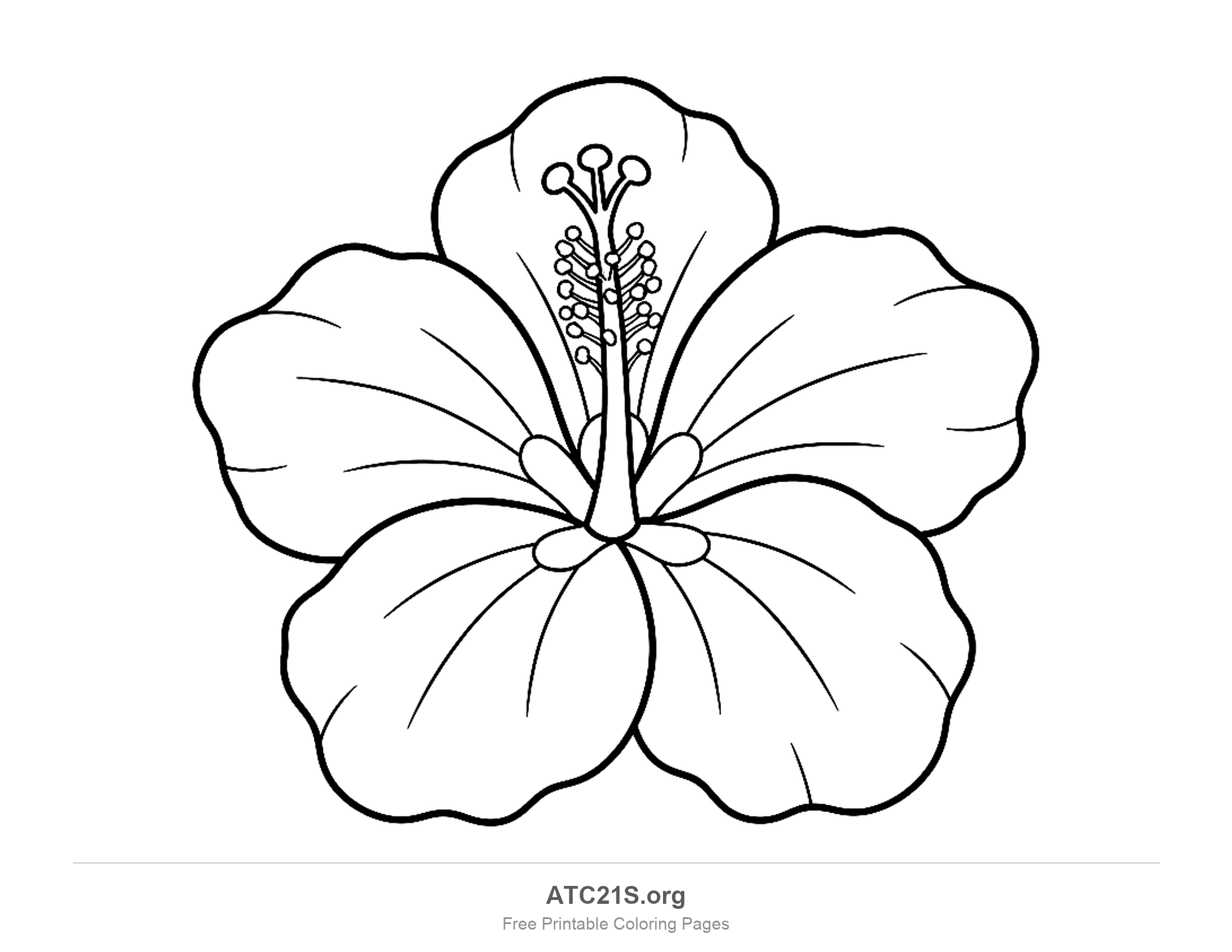
The eight designs get steadily harder. First is a single hibiscus seen straight on, with five broad petals, a few short vein lines, small rounded shapes at the heart of the flower and the column standing straight up, all in thick outlines that suit toddlers still learning to stay inside the lines. Then the same front view with more to follow: long veins fanning across every petal and a fluffy cluster of pollen bunched along the column. The third sheet turns the flower slightly to one side on a short curving stem with two toothed leaves, its column reaching out to the top corner, and the fourth shows it from the side, so the petals flare out from a narrow trumpet held in a cup of pointed green sepals, with two leaves on the stem below. After that the drawings add more to do: two blooms side by side on a forked stem, each with its own column, with a leaf peeking out between them; a hibiscus resting on three big jagged tropical leaves that stretch the width of the page, like the pattern on a Hawaiian shirt; a branch running across the page with a closed bud at one end, an open flower at the other and five veined, toothed leaves; and finally a hibiscus with ruffled, crinkled petal edges and fine lines fanning over every petal, above a small bud and two leaves, for children who like a long, careful page.
The column in the middle is the detail worth pausing on. In most flowers the parts that make pollen (the stamens) and the part that catches it (the pistil) stand separately, but in a hibiscus the stamens are joined into a tube wrapped round the pistil, so they share one long spike. The knobs along its sides carry the pollen, and the round pads at the very tip catch pollen brought from other flowers — a real hibiscus has five of them, and children can count how many each drawing shows. When a bee, a butterfly or a hummingbird pushes in for the nectar at the bottom of the flower, it brushes against the column and carries pollen away. It is also worth knowing that most hibiscus flowers last only a day or two before they wilt, so a plant keeps opening new ones from buds like the one on the branch sheet.
Every sheet prints on landscape US Letter paper at 200 DPI, so the hibiscus fills the page without being cut off. Plain copier paper is fine for crayons and colored pencils. If you are using markers or paint, slightly thicker card stock stops the colour bleeding through — worth doing on the two-bloom, branch and ruffled-petal sheets, where the stamens, the leaf veins and the crinkled petal edges put the lines closest together.
In the classroom these pages pair well with a lesson on plant parts (petal, stamen, sepal, leaf), on islands and tropical places, on pollinators, or on the letter H. Print the front view next to the side view and let children find the same column from two angles, or hand out the simple bloom for a quick, cheerful page and save the ruffled one for a quiet afternoon. The mixed flower page has a hibiscus with a bud alongside a tulip, an orchid and a lotus, the rose coloring pages make a good contrast because a garden rose packs its petals into a tight spiral where a hibiscus spreads five wide open, and the printable sunflowers are another big, bright summer bloom. Hummingbirds in the Americas sip nectar from hibiscus and come away with pollen on their heads, the butterfly sheets show another regular visitor, and because the hibiscus is Malaysia's national flower, the Malaysian flag page makes an easy geography link. For a whole tropical scene, pair a hibiscus with one of the printable palm trees that grow alongside it on the same islands. The color-by-number math generator makes a practice sheet to go with it, and the trees, skies and landscapes are in the rest of the nature coloring pages.
keep coloring