NatureFlowers8 designsFree to print
print, color, learn
Free Daisy Coloring Pages
Eight free printable daisy coloring pages, from a smiling cartoon daisy with big rounded petals for little hands to a bloom with long slender petals around a centre packed with tiny dots for older kids. Download the PNG or print straight from this page.
share:
pick a favourite
8 Daisy designs to color
Tap any sheet for a closer look, then download or print it.
Daisy Coloring Page - Simple Upright Bloom
Daisy Coloring Page - Small Bloom Tall Stem
Daisy Coloring Page - Tilted Bloom Curved Stem
Daisy Coloring Page - Wide Petals Big Dotted Centre
Daisy Coloring Page - Double Ring Of Petals
Daisy Coloring Page - Textured Centre Disc
Daisy Coloring Page - Long Slender Petals
quick instructions
How to download and print
1. Pick your sheet
Preview any design below and choose the one you like best.
2. Print or download
Print straight from the page, or save the PNG to print later.
3. Color it in
Crayons, colored pencils or markers — plain paper works fine.
Every sheet is sized for landscape US Letter (11" x 8.5") at 200 DPI, so it fills the page without cropping. A4 works too — choose "fit to page" when printing.
while you color…
6 fun facts about the daisy
The name daisy comes from the Old English for "day's eye", because the flower opens in the morning and closes at night.
Each white "petal" on a daisy is really a separate tiny flower, and the yellow middle is made of many more tiny flowers packed together.
Daisies belong to the same plant family as sunflowers, dandelions and even lettuce.
That family is one of the biggest on Earth, with more than 30,000 different kinds of plant.
Common daisies close up in rainy or cloudy weather as well as at night.
Common daisy leaves grow in a flat circle close to the ground, which is why the plant can survive being mowed with the lawn.
About the daisy coloring page
Daisies are some of the most familiar wildflowers there are. The little common daisy grows low in lawns, parks and school playing fields, and the taller ox-eye daisy fills summer meadows and roadsides. Children pick them, thread them into daisy chains and pull off the petals one by one for "loves me, loves me not", and when a child is asked to draw a flower, what usually comes out is a daisy: a round middle, a ring of petals and a stem. That makes a daisy page one of the easiest to hand over, at almost any age. This page has eight of them, from a smiling cartoon daisy to a bloom with long, slender petals.
A real daisy has white petals around a bright yellow middle, on a green stem. Look closely at a common daisy in the grass and the petal tips are often pink or red underneath, and garden gerbera daisies come in orange, pink, red and yellow as well. That is a perfectly good way to color these sheets. It is also fine to ignore it. A purple daisy, a blue one or one with every petal a different colour is just as welcome. The shapes worth pointing out are the round middle and the single ring of narrow petals, all about the same size, spreading out from it like the spokes of a wheel — those are what make a daisy look like a daisy rather than a rose or a tulip.
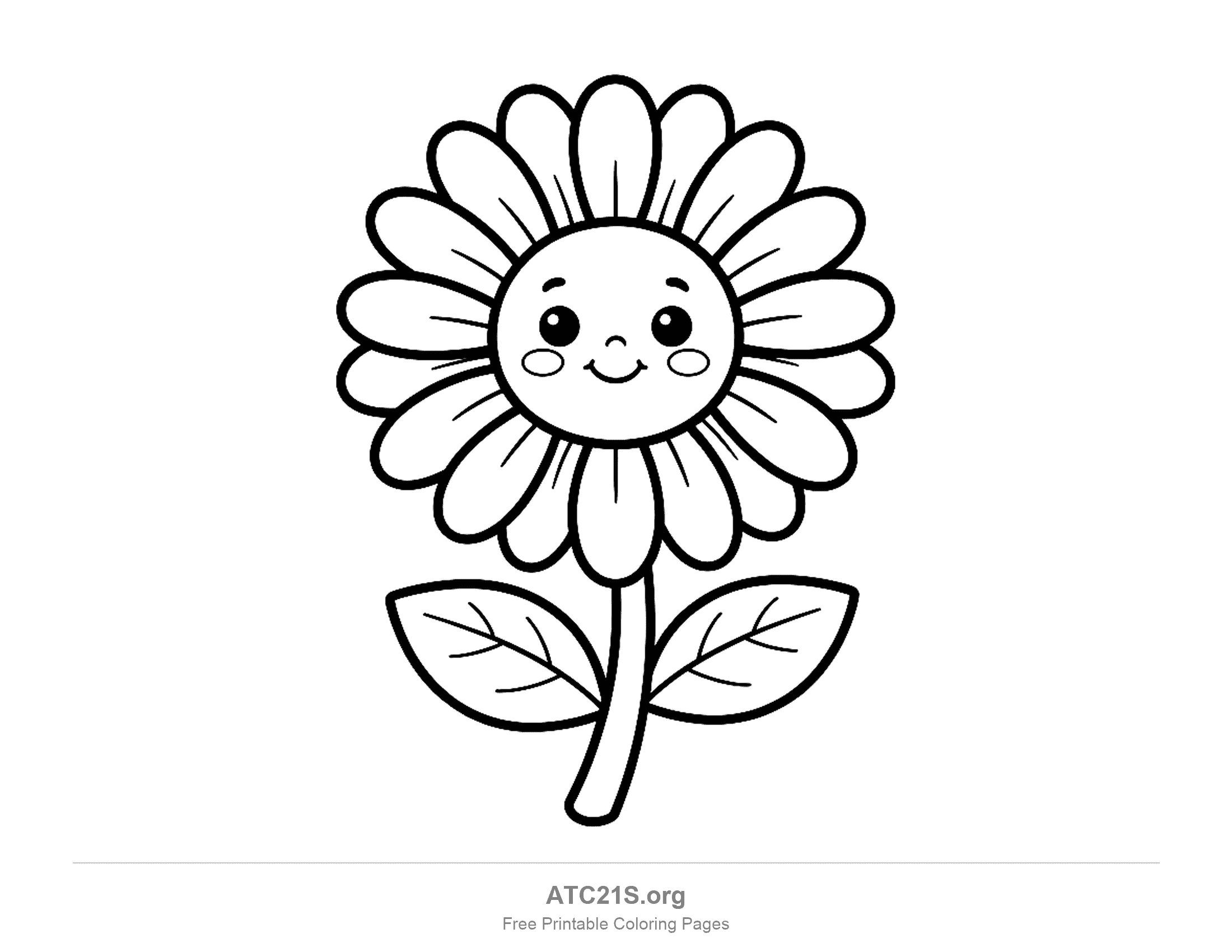
The eight designs get steadily harder. First is a cartoon daisy with a smiling face, round eyes and blushing cheeks filling the whole middle, big rounded petals and two veined leaves on a short curving stem, all in thick outlines that suit toddlers still learning to stay inside the lines. Then an upright daisy with one ring of plain rounded petals, a frilly middle edged with little curls, a straight stem and two simple leaves, and a smaller daisy on a tall, slightly bending stem with two broad leaves halfway up and a few dots sprinkled in its centre. The fourth sheet has a daisy leaning to one side on a curving stem, with its two leaves at different heights and a middle full of little bubbles. After that the drawings add more to do: a daisy with wide rounded petals and a second ring peeking out behind them, around a big centre scattered with circles of different sizes; a full bloom with two whole rings of petals, each marked with crease lines; a daisy whose large centre disc is filled with dots, dashes and tiny seed shapes above two big veined leaves; and finally a daisy with dozens of long, slender, pointed petals around a middle packed with small circles, for children who like a long, careful page.
The middle of the daisy is the detail worth pausing on. It looks like one yellow button, but it is really dozens or even hundreds of tiny flowers packed together, and each white "petal" round the edge is a separate little flower too. The dots and circles in the centres of most of these sheets are a simple way to show that, and older children can color them one by one. Sunflowers are built exactly the same way, because they belong to the same plant family — put a daisy next to one of the sunflower coloring pages and children can spot the matching parts. The name is worth a minute as well: "daisy" comes from "day's eye", because the common daisy opens in the morning and folds its petals shut at night.
Every sheet prints on landscape US Letter paper at 200 DPI, so the daisy fills the page without being cut off. Plain copier paper is fine for crayons and colored pencils. If you are using markers or paint, slightly thicker card stock stops the colour bleeding through — worth doing on the double-ring, textured-centre and long-slender-petal sheets, where the crease lines and the dotted middles put the lines closest together.
In the classroom these pages pair well with a lesson on plant parts (petal, stem, leaf, centre), on spring and what grows in a lawn, on pollinators, or on the letter D. Take the class outside to find real daisies first, then color the cartoon daisy for a quick, cheerful page and save the long-petalled one for a quiet afternoon. For a thank-you card, a printable bouquet gathers daisies together with roses and tulips in a ribbon-tied bunch, a teacup or a basket. The mixed flower page starts with a simple daisy and moves on to a tulip, a daffodil and an orchid, the rose sheets make a good contrast for a garden lesson, a bee page shows one of the insects that visits daisies for pollen and nectar, and the butterfly coloring pages add another. The color-by-number math generator makes a practice sheet to go with it, and the trees, skies and landscapes are in the rest of the nature coloring pages.
keep coloring