AnimalsInsects8 designsFree to print
print, color, learn
Free Butterfly Coloring Pages
Eight free printable butterfly coloring pages, from a chunky-outline smiling cartoon for little hands to a finely celled monarch for older kids. Download the PNG or print straight from this page.
share:
pick a favourite
8 Butterfly designs to color
Tap any sheet for a closer look, then download or print it.
Butterfly Coloring Page - Simple Long-Tailed
Butterfly Coloring Page - Cute Flying
Butterfly Coloring Page - Cute Perched
Butterfly Coloring Page - Hearts and Stars
Butterfly Coloring Page - Floral Swirl Wings
Butterfly Coloring Page - Detailed Swallowtail
Butterfly Coloring Page - Detailed Monarch
quick instructions
How to download and print
1. Pick your sheet
Preview any design below and choose the one you like best.
2. Print or download
Print straight from the page, or save the PNG to print later.
3. Color it in
Crayons, colored pencils or markers — plain paper works fine.
Every sheet is sized for landscape US Letter (11" x 8.5") at 200 DPI, so it fills the page without cropping. A4 works too — choose "fit to page" when printing.
while you color…
6 fun facts about the butterfly
A butterfly tastes with its feet — it lands on a flower and checks it before drinking.
Butterflies have four wings, not two, and the front pair and the back pair beat together.
A monarch butterfly can fly more than 2,000 miles from Canada down to Mexico for the winter.
A butterfly's tongue is a long straw called a proboscis, and it rolls up like a party blower when not in use.
Every butterfly starts as an egg, then a caterpillar, then a chrysalis, and only then becomes a butterfly.
The dust that rubs off a butterfly's wings is made of tiny overlapping scales, like roof tiles.
About the butterfly coloring page
Butterflies are insects with four wings, found on every continent except Antarctica. A grown butterfly drinks nectar through a long, coiled tongue called a proboscis, and most species live only a few weeks as adults — though the monarch, which migrates thousands of miles, can live several months. Children meet them in gardens, on walks, and in the life-cycle posters that hang in almost every classroom, which makes a butterfly page one of the easiest animals to talk about while coloring.
The wings are the fun part, and they are always a matching pair. Real butterflies come in almost every color: monarchs are orange and black, many swallowtails are yellow and black, and the long-tailed luna moth — a close cousin — is pale green. There is no single "right" butterfly, so children can copy a species they know or invent a rainbow one. A useful prompt is to color the left and right wings the same, which turns the page into a first lesson in symmetry without anyone having to say the word.
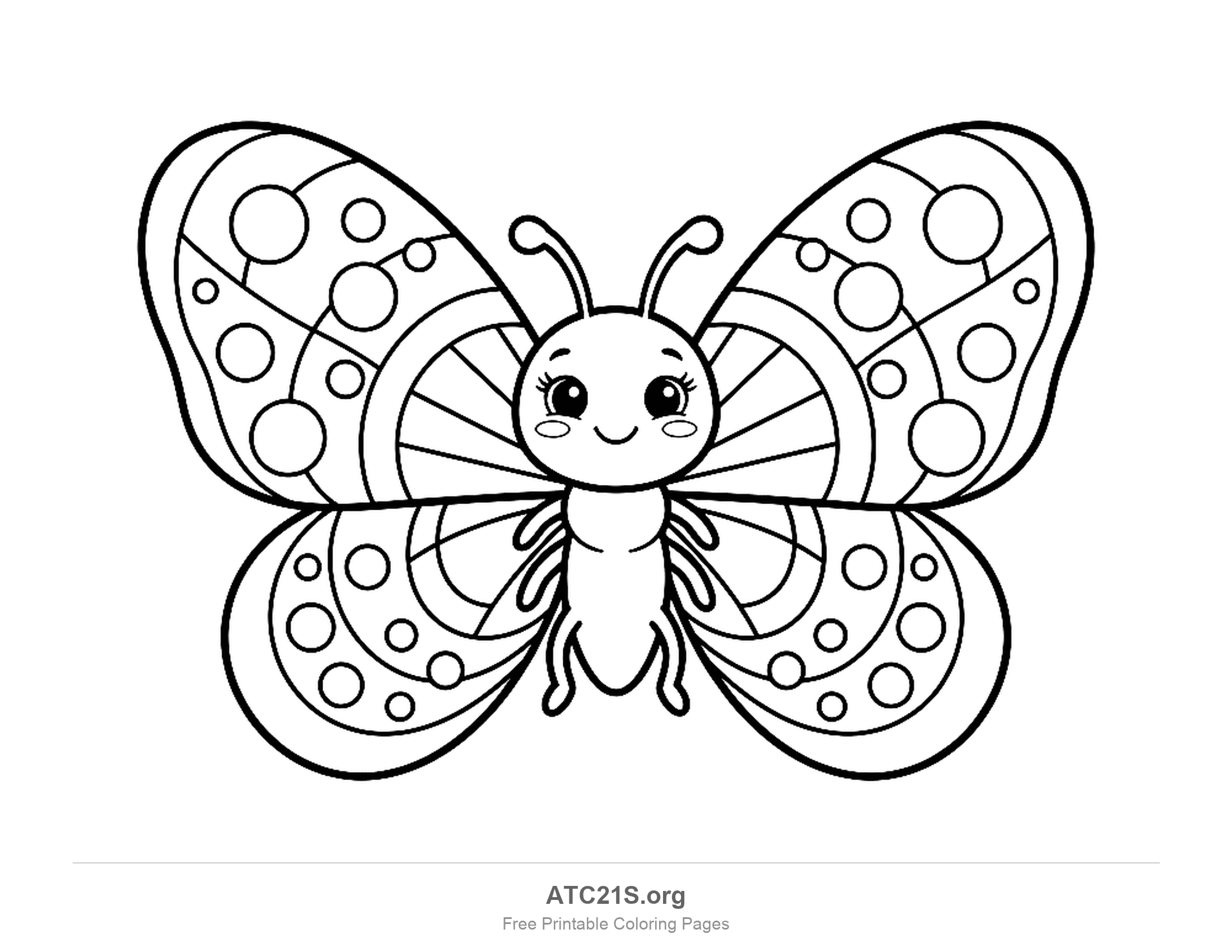
The eight designs get steadily harder. The smiling cartoon with big polka-dot wings comes first — thick outlines and large round shapes for toddlers still learning to stay inside the lines. Next is a long-tailed luna-style butterfly whose wing panels are big and mostly empty, then a cute butterfly flying at an angle and one perched on a twig, both still friendly but with more pattern on the wings. The middle sheets fill the wings with hearts and stars, then with petal shapes and swirls, which suit children who like decorating. The last two are the longer projects: a swallowtail with pointed hindwing tails and eyespots, and a monarch whose wings are divided into dozens of small cells for children who want a careful, sit-down page.
Every sheet prints on landscape US Letter paper at 200 DPI, so the butterfly fills the page without being cut off. Plain copier paper is fine for crayons and colored pencils. If you are using markers or paint, slightly thicker card stock stops the color bleeding through — worth doing on the last two sheets, where the thin wing cells sit close together.
In the classroom these pages pair well with a lesson on insect life cycles (egg, caterpillar, chrysalis, butterfly), on pollinators and gardens, on symmetry, or on the letter B. Print the easy polka-dot sheet and the detailed monarch side by side and let children see how the same animal can be drawn two ways. Finished pages pin up as a spring wall, and the hearts-and-stars design is a natural pick for Valentine's week. The bee and bug pages cover the rest of the garden, a daisy or sunflower to color gives the butterfly somewhere to feed, and the animals category has the bigger animals.
Printing two or three different designs and letting each child pick keeps a mixed-age group busy at the same table, since the smiling dotted butterfly is finished in a few minutes and the monarch can fill a whole quiet afternoon.