NatureFlowers8 designsFree to print
print, color, learn
Free Rose Coloring Pages
Eight free printable rose coloring pages, from a single rose bud on a straight stem for little hands to an ornate bloom with swirling petal tips and a thorny stem for older kids. Download the PNG or print straight from this page.
share:
pick a favourite
8 Rose designs to color
Tap any sheet for a closer look, then download or print it.
Rose Coloring Page - Cute Smiling Face With Bud
Rose Coloring Page - Chubby Rounded Petals
Rose Coloring Page - Wide Open Bloom
Rose Coloring Page - Compact Bloom Short Stem
Rose Coloring Page - Half Open Side View
Rose Coloring Page - Layered Bloom Thorny Stem
Rose Coloring Page - Ornate Curled Petals
quick instructions
How to download and print
1. Pick your sheet
Preview any design below and choose the one you like best.
2. Print or download
Print straight from the page, or save the PNG to print later.
3. Color it in
Crayons, colored pencils or markers — plain paper works fine.
Every sheet is sized for landscape US Letter (11" x 8.5") at 200 DPI, so it fills the page without cropping. A4 works too — choose "fit to page" when printing.
while you color…
6 fun facts about the rose
Wild roses usually have just five petals; the many-layered roses in gardens were bred over hundreds of years to grow extra ones.
The sharp points on a rose stem are really prickles, not thorns — they grow from the stem's outer skin and can snap off cleanly.
Roses belong to the same plant family as apples, pears, cherries and strawberries.
When a rose flower fades it can leave behind a round fruit called a rose hip, which is packed with vitamin C.
There is no naturally blue rose, because roses do not make the pigment that turns flowers blue — blue roses in shops are dyed.
Fossils show that roses were already growing on Earth about 35 million years ago.
About the rose coloring page
Roses are flowering shrubs that grow wild across much of the northern half of the world and in gardens almost everywhere else, climbing over fences, scrambling up walls and filling park borders. They are one of the first flowers children learn to name, partly because they turn up on birthday cards, in fairy tales and in shop windows, and partly because the swirl of petals in the middle is such a satisfying shape to draw and color. This page has eight roses, from a single bud on a straight stem to an ornate bloom with curling petal tips.
Garden roses come in red, pink, white, yellow, orange, peach and a deep plum, and some are striped or change colour from the edge of the petal to the base. That is a perfectly good way to color these sheets. It is also fine to ignore it. There is no naturally blue rose, which makes a blue one a fun thing to invent on paper, and a rainbow rose is just as welcome. The shapes worth pointing out are the spiral of petals wrapped tightly round the centre, the pointed green leaves with their toothed edges, and the prickles on the stem — those are what make a rose look like a rose rather than a peony or a tulip.
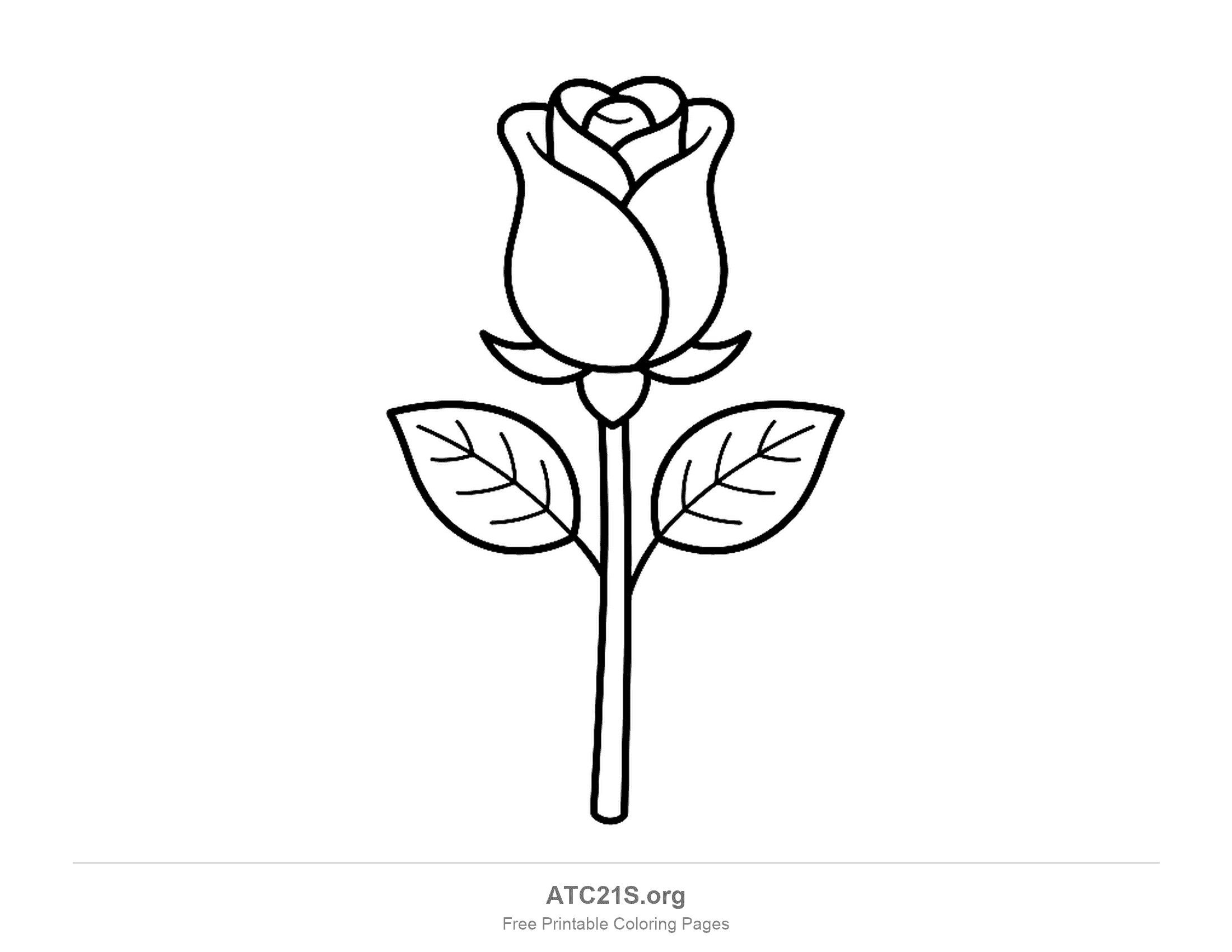
The eight designs get steadily harder. First is a single rose bud on a long straight stem, with two veined leaves and small green flaps curling under the bud, all in thick outlines that suit toddlers still learning to stay inside the lines. Then a cartoon rose with a smiling face, round eyes and blushing cheeks in the middle of the bloom, plus a little bud on a side stem, and a chubby rose whose puffy, rounded petals look almost like a cloud around a spiral centre. The fourth sheet is a wide-open bloom with broad petals and four leaves at the base, still in bold lines but with more petals to fill. After that the drawings add more to do: a compact rose packed with layers of petals on a short stem, a half-open rose seen from the side with its outer petals folding back and long pointed sepals reaching out beneath it, a full layered bloom on a branching thorny stem with five toothed leaves, and finally an ornate rose whose petal edges curl into little swirls, with veined leaves and thorns, for children who like a long, careful page.
The green flaps under the bud on the first and sixth sheets are worth pausing on. They are called sepals, and before the rose opens they wrap right round the bud to protect it; once the petals unfold, the sepals fold back underneath. Most roses have five of them. Wild roses usually have just five petals in a flat ring as well — the deep, many-layered roses on most of these sheets are garden roses, bred over hundreds of years to grow extra petals. The prickles are a good talking point too: they grow from the outer skin of the stem and help the plant hook onto things as it climbs.
Every sheet prints on landscape US Letter paper at 200 DPI, so the rose fills the page without being cut off. Plain copier paper is fine for crayons and colored pencils. If you are using markers or paint, slightly thicker card stock stops the colour bleeding through — worth doing on the layered-bloom and ornate-rose sheets, where the leaf veins, the thorns and the curled petal tips put the lines closest together.
In the classroom these pages pair well with a lesson on plant parts (petal, sepal, stem, leaf), on spring and summer gardens, on making a card for Valentine's Day or Mother's Day, or on the letter R. Print the bud next to the wide-open bloom and let children put the stages in order, or hand out the cartoon rose for a quick, cheerful page and save the ornate one for a quiet afternoon. For a Mother's Day card, a daisy coloring page makes a simple partner to the rose, and a printable hibiscus makes a tropical contrast, opening five wide petals around a long stamen where a rose wraps its petals into a spiral, and the bouquet of flowers coloring pages tuck roses in beside daisies, tulips and lilies for a whole Mother's Day bunch. The flower coloring pages put a garden rose alongside a daisy, a tulip and a sunflower, the printable sunflowers make a bright summer contrast with a big seed-filled middle in place of a spiral of petals, the ladybug in the bug sheets is the insect gardeners like to see on their roses because it eats the aphids clustered on the stems, and a bee page shows a visitor that comes to open roses for pollen. To see roses growing in a garden, the garden coloring pages train them over an old stone archway and a wooden arch beside a thatched cottage. The trees, skies and landscapes are in the rest of the nature coloring pages.
keep coloring