NatureFlowers8 designsFree to print
print, color, learn
Free Bouquet of Flowers Coloring Pages
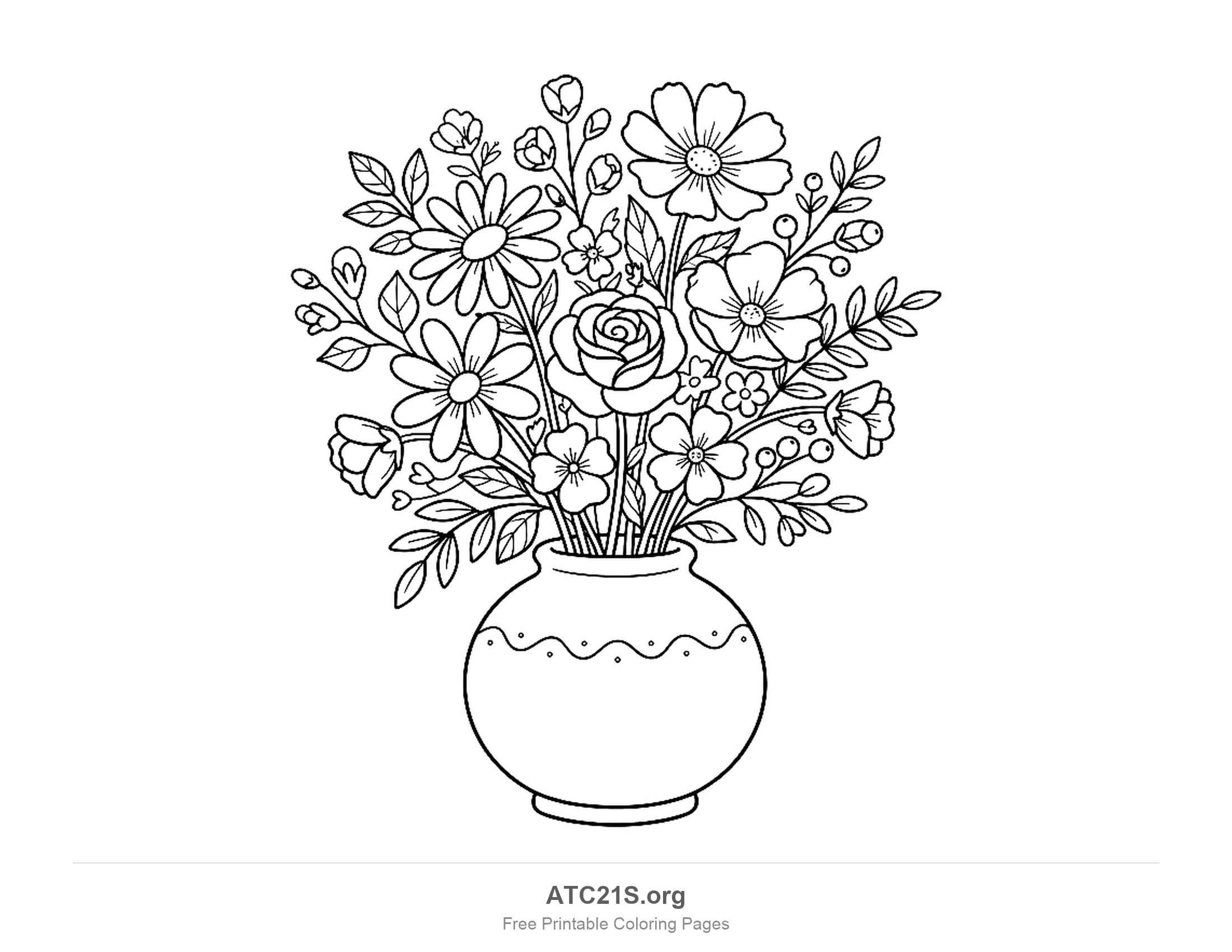
Eight free printable bouquet coloring pages, from a round vase of big daisies and a rose for younger kids to a heart-shaped bouquet packed with roses, tulips and a sunflower for older kids. Download the PNG or print straight from this page.
share:
pick a favourite
8 Bouquet of Flowers designs to color
Tap any sheet for a closer look, then download or print it.
Bouquet of Flowers Coloring Page - Tied With Big Ribbon Bow
Bouquet of Flowers Coloring Page - Teacup And Saucer
Bouquet of Flowers Coloring Page - Loose Stems Falling Petals
Bouquet of Flowers Coloring Page - Mason Jar With Lavender
Bouquet of Flowers Coloring Page - Paper Wrapped Twine Bow
Bouquet of Flowers Coloring Page - Woven Basket With Bow
Bouquet of Flowers Coloring Page - Heart Shaped Arrangement
quick instructions
How to download and print
1. Pick your sheet
Preview any design below and choose the one you like best.
2. Print or download
Print straight from the page, or save the PNG to print later.
3. Color it in
Crayons, colored pencils or markers — plain paper works fine.
Every sheet is sized for landscape US Letter (11" x 8.5") at 200 DPI, so it fills the page without cropping. A4 works too — choose "fit to page" when printing.
while you color…
6 fun facts about the bouquet of flowers
Cut flowers keep drinking water through their stems, which is why trimming the ends and giving them fresh water helps a bouquet last longer.
Tulips keep growing after they are cut, and can stretch an inch or more taller in the vase.
In Victorian times people used a "language of flowers", where each kind of bloom stood for a different feeling, so a bouquet could carry a secret message.
A small, round bouquet is sometimes called a posy or a nosegay, because people once carried sweet-smelling flowers to hold up to their noses.
The first official Mother's Day in the United States, in 1908, was marked with white carnations.
The Netherlands sells more cut flowers to other countries than anywhere else, and its huge flower auction at Aalsmeer trades millions of flowers every day.
About the bouquet of flowers coloring page
A bouquet is a bunch of cut flowers gathered together and given to someone, and most children have seen one handed over on a birthday, on Mother's Day, at a wedding, to a teacher at the end of term or to someone who is poorly. That makes it a coloring page with a purpose: a finished bouquet is a present in itself, and it folds neatly into a card. Each sheet is also several flowers in one, plus something to hold them — a ribbon, a paper wrap, a vase, a teacup or a basket — so there is more to choose and more to color than on a single bloom. This page has eight bouquets, from a round vase of big daisies to a heart made entirely of flowers.
Real bouquets mix colours on purpose: red and pink roses, white daisies with yellow middles, golden sunflowers, tulips in almost any colour, and plenty of green leaves and sprigs of berries to fill the gaps. That is a perfectly good way to color these sheets. It is also fine to ignore it. A bouquet in every shade of purple, or one where each flower is a different colour of the rainbow, is just as welcome, and choosing a colour scheme before starting is a nice way to make the page feel planned. The shapes worth pointing out are the ones that tell the flowers apart: the spiral of petals on a rose, the round middle and ring of petals on a daisy or sunflower, the closed cup of a tulip, and the six pointed petals of a lily with its long stamens poking out.
The eight designs get steadily harder. First is a round vase with a wavy band of dots, holding two big daisies, a rose, a few five-petalled blossoms, rosebuds and sprigs of berries — the boldest outlines and biggest open spaces in the set, and a good first bouquet for younger children. Then a hand-tied bunch in a paper cone with a large ribbon bow and its tails hanging down, the stem ends showing at the bottom, holding tulips, a rose, daisies, a sunflower with a dotted middle and two lilies. The third sheet sets the flowers in a teacup on a saucer, the cup itself painted with little flowers and swirls under a scalloped rim, with roses, daisies and tulips spilling out of the top. After that the drawings add more to do: a loose bunch of long stems with no wrapping at all, roses, tulips, lilies, daisies and a sunflower with petals drifting down around it; a glass mason jar with a wire handle, half full of water so the stems show through the glass, holding daisies, a rose, a tulip, a sunflower, sprigs of lavender and berries, with "MASON" moulded into the jar the way a real one is; a bouquet wrapped in paper and tied with a twine bow, with two roses, daisies, round eucalyptus-style leaves, berries, lavender sprigs and tiny clusters of baby's breath; a woven basket with a twisted handle and a bow on top, packed with poppies, roses, a sunflower, tulips, lilies and daisies above a basket weave of dozens of little rectangles; and finally a heart-shaped bouquet with a scalloped edge and a ribbon tied round the stems, filled edge to edge with a rose, two tulips, a sunflower with a criss-cross middle, a lily, daisies, berries and tiny hearts, for children who like a long, careful page.
Spotting which flowers are in each bouquet is the detail worth pausing on. Most of these sheets mix five or six kinds, and children can hunt for the rose, the tulip, the daisy and the sunflower before they start, then compare them with the single blooms on the rose coloring pages, the daisy sheets and the printable sunflowers. It is also a good moment to talk about cut flowers: even off the plant, a flower keeps drinking water up through its stem, which is why bouquets go in a vase (the mason-jar sheet shows the stems standing in the water) and why florists trim the stem ends. Stand a white flower in water with a few drops of food colouring and, over a day or two, the petals take up the colour — a simple experiment to run alongside the coloring.
Every sheet prints on landscape US Letter paper at 200 DPI, so the bouquet fills the page without being cut off. Plain copier paper is fine for crayons and colored pencils. If you are using markers or paint, or want to fold the page into a card, slightly thicker card stock stops the colour bleeding through and holds its shape — worth doing on the paper-wrapped, basket and heart sheets, where the baby's breath, the basket weave and the tightly packed flowers put the lines closest together.
In the classroom these pages pair well with Mother's Day, thank-you cards for teachers and helpers, birthdays, a lesson on plant parts and seasons, or the letter B. Hand out the round vase for a quick, cheerful card and save the heart for a quiet afternoon, or let each child pick the holder they like best and write a message on the back. The flower coloring pages give children a single tulip, rose or sunflower to practise on first, the butterfly sheets and a bee page show the insects that visit these flowers while they are still growing, and the color-by-number math generator makes a practice sheet to go with it. The trees, skies and landscapes are in the rest of the nature coloring pages.