NatureSky & Weather7 designsFree to print
print, color, learn
Free Snowflake Coloring Pages
Seven free printable snowflake coloring pages, from a chunky six-sided snowflake drawn in thick, simple outlines for little hands to a fine, feathery fern-like crystal for older kids. Download the PNG or print straight from this page.
share:
pick a favourite
7 Snowflake designs to color
Tap any sheet for a closer look, then download or print it.
Snowflake Coloring Page - Bubble Tipped Arms
Snowflake Coloring Page - Smiling Hexagon Face
Snowflake Coloring Page - Heart Tipped Arms
Snowflake Coloring Page - Classic Six Point Star
Snowflake Coloring Page - Geometric Diamond Lattice
Snowflake Coloring Page - Fine Fern Dendrite
quick instructions
How to download and print
1. Pick your sheet
Preview any design below and choose the one you like best.
2. Print or download
Print straight from the page, or save the PNG to print later.
3. Color it in
Crayons, colored pencils or markers — plain paper works fine.
Every sheet is sized for landscape US Letter (11" x 8.5") at 200 DPI, so it fills the page without cropping. A4 works too — choose "fit to page" when printing.
while you color…
6 fun facts about the snowflake
Snow crystals always have six arms or six sides, because water molecules lock together in a six-sided pattern when they freeze.
A snowflake begins high in a cloud, when water vapour freezes onto a tiny speck of dust or pollen.
Snowflakes are made of clear ice. Snow looks white because light bounces off all the tiny ice surfaces in every direction.
The shape of a snowflake depends on the temperature: the classic feathery star shape grows best at around minus 15 degrees Celsius.
A farmer named Wilson Bentley took the first photograph of a single snowflake in 1885 and went on to photograph more than 5,000 of them.
Snowflakes fall slowly, usually at about walking pace, which is why they seem to drift rather than drop like rain.
About the snowflake coloring page
Snowflakes are the first sign that a winter day is going to be a good one. Children catch them on their tongues, watch them settle on a dark coat sleeve and press their noses to the window to see if they are sticking. They also turn up everywhere in winter, on jumpers, cards, paper chains and classroom windows, so a snowflake is a shape most children already know how to draw. The seven sheets here are all single snowflakes drawn big in the middle of the page, from a bold, chunky one with a handful of big spaces to a fine crystal with hundreds of tiny branches, so there is a sheet for every age and every length of attention span.
A real snowflake is made of clear ice, and it only looks white because light bounces off its many tiny faces in every direction. That leaves the colour completely open. Pale blue and silver are the classic winter choice, white crayon on blue paper looks lovely, and a snowflake coloured in rainbow stripes, one colour per arm, or in pink and purple is just as welcome. What makes the shape read as a snowflake is one rule: six arms spreading out from the middle, each one the same, with smaller branches growing off it like the side shoots of a fern. Every sheet here keeps that rule, so even the simplest one looks right when it is finished.
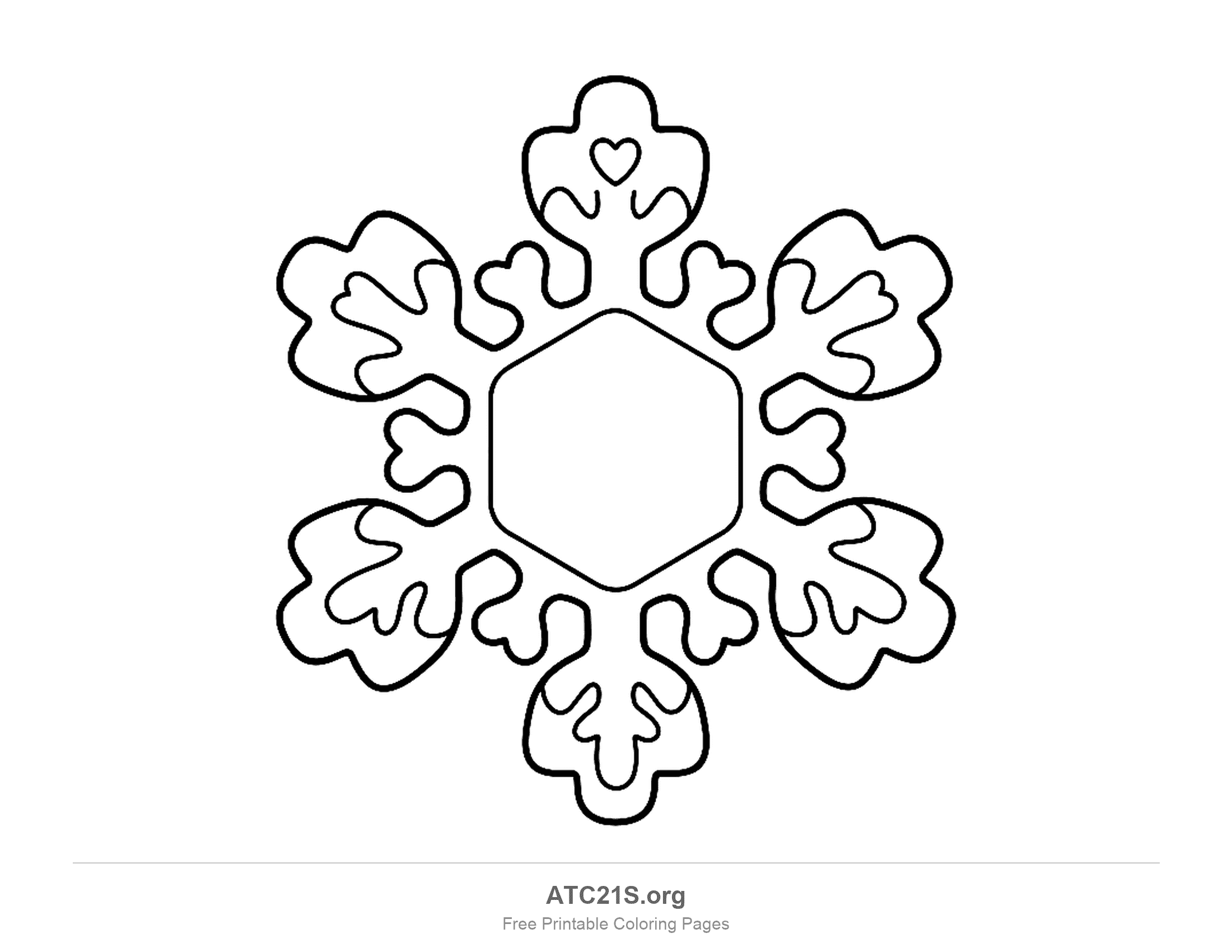
The seven designs get steadily harder. First is a chunky snowflake drawn in the thickest outlines of the set, a plain hexagon in the middle with six short, rounded arms that end in little cloud-shaped tips and a tiny heart tucked into the top one, so the spaces are big and it suits toddlers still learning to stay inside the lines. Next is a six-armed snowflake with a small star inside a circle at its centre, a pair of short side branches on each arm and a round bubble on the end of every arm, which gives six circles to colour in six different colours. The third sheet is a cute snowflake with a smiling face inside its hexagon, big round eyes and rosy cheeks, and six arms decorated with diamonds, dots and small branches. The fourth is a snowflake built out of hearts: a tiny heart tips every arm and every branch, with a six-pointed star in the middle, which makes a good valentine as well as a winter page. The fifth is the classic six-pointed snowflake, each arm carrying a diamond and a feathered tip, with a ring of small diamonds round the centre, for children who want the snowflake they picture in their heads. The sixth is a geometric snowflake made almost entirely of diamonds and chevrons that nest inside one another, with a hexagon at the heart, and the last sheet is a fine, feathery dendrite crystal, each arm covered in tiny leaf-shaped side branches, for older children who like a long, careful page.
The lesson that goes with these pages is the number six. Every real snow crystal is built on six: it has six arms or six sides, never five and never eight, because of the way water freezes: as water molecules lock together into ice, they line up in a six-sided pattern, and the crystal grows outwards from that hexagon. Children can count the arms on each sheet and spot the hexagon at the centre of the first one, then compare it with the five points on the star coloring pages, and the number 6 coloring page makes a natural partner. The other famous fact is that no two snowflakes are alike. Each crystal takes its own path down through the cloud, through slightly different cold and damp air, and every change adds branches in a slightly different way. Because all six arms make that journey together, they grow to match each other, while the next snowflake ends up a little different, which is exactly what the seven sheets show side by side. A snowflake starts high in a cold cloud, when water vapour freezes onto a speck of dust, which is why the cloud coloring pages belong next to these. Snow is not frozen rain, which is called sleet, but the two are close relatives: much of the rain that falls actually starts as snow high up and melts on the way down, so the rain sheets show what happens to a snowflake on a warmer day. The air also gets colder the higher you go, so snow settles first and stays longest on high ground, which is why the peaks on the printable mountains wear white caps. Cutting paper snowflakes makes the six-arm rule stick. If children fold their paper into quarters, they get eight arms, which real snowflakes never have; folding a triangle into thirds gives the right six.
Every sheet prints on landscape US Letter paper at 200 DPI, so the snowflake fills the page without being cut off. Plain copier paper is fine for crayons and colored pencils. If you are using markers or paint, slightly thicker card stock stops the colour bleeding through. It is worth doing on the last three sheets, the classic star, the diamond lattice and the feathery dendrite, where the nested diamonds and the tiny side branches put the lines closest together.
In the classroom these pages pair well with a lesson on winter and the seasons, the weather, symmetry, counting to six, or the letter S. A row of coloured snowflakes, each one decorated differently, makes a good window display and shows the no-two-alike idea at a glance, and the heart snowflake doubles as a Valentine's Day sheet. Animals that live in the snow make good partners: a polar bear has fur on the soles of its feet to keep them warm and stop it slipping on the ice, which the polar bear coloring pages are good for, and a printable penguin is a good reminder that emperor penguins huddle together in their thousands to get through Antarctic blizzards. The sun, the moon, the rainbow and the rest of the sky are in the nature coloring pages.