NatureSky & Weather8 designsFree to print
print, color, learn
Free Moon Coloring Pages
Eight free printable moon coloring pages, from a big smiling full moon in thick outlines for little hands to a winking full moon dotted with craters for older kids. Download the PNG or print straight from this page.
share:
pick a favourite
8 Moon designs to color
Tap any sheet for a closer look, then download or print it.
Moon Coloring Page - Sleeping Crescent Moon
Moon Coloring Page - Laughing Crescent Moon
Moon Coloring Page - Starry Eyed Crescent Moon
Moon Coloring Page - Sleepy Moon In Nightcap
Moon Coloring Page - Crescent Profile With Craters
Moon Coloring Page - Sparkle Eyed Moon With Freckles
Moon Coloring Page - Winking Full Moon With Craters
quick instructions
How to download and print
1. Pick your sheet
Preview any design below and choose the one you like best.
2. Print or download
Print straight from the page, or save the PNG to print later.
3. Color it in
Crayons, colored pencils or markers — plain paper works fine.
Every sheet is sized for landscape US Letter (11" x 8.5") at 200 DPI, so it fills the page without cropping. A4 works too — choose "fit to page" when printing.
while you color…
6 fun facts about the moon
The moon has no light of its own. It shines because sunlight bounces off it.
Twelve astronauts have walked on the moon. The first were Neil Armstrong and Buzz Aldrin in July 1969.
There is no wind or rain on the moon, so the astronauts' footprints are probably still there.
The moon goes all the way around the Earth in about 27 days, and the same side of it always faces us.
You would weigh about one sixth as much on the moon, so you could jump about six times higher.
Monday is named after the moon. In Old English it was called Mōnandæg, which means the moon's day.
About the moon coloring page
The moon is the biggest, brightest thing in the night sky, and for many children it is the first thing they point at from a car window or a bedroom curtain. It turns up in bedtime stories, lullabies and picture books, it changes shape from one week to the next, and it can often be spotted in the daytime sky too. That makes a moon page an easy one to hand over at bedtime or in a quiet moment at school. Every sheet here is a friendly moon with a face: two round full moons and six crescents, sleeping, laughing, winking and wide awake.
Look at the real moon and it is a soft silvery white or pale grey, sometimes creamy yellow, and close to the horizon it can glow orange. Most children reach for yellow, grey or simply leave it white and colour a dark blue or black night sky around it, which is a lovely way to finish one of these sheets. It is just as fine to make it pink, purple or striped, and the rosy cheeks on several faces are a good spot for a different colour. Two shapes make a picture read as the moon: a full round circle, or a curved crescent shaped like the letter C, and both appear here.
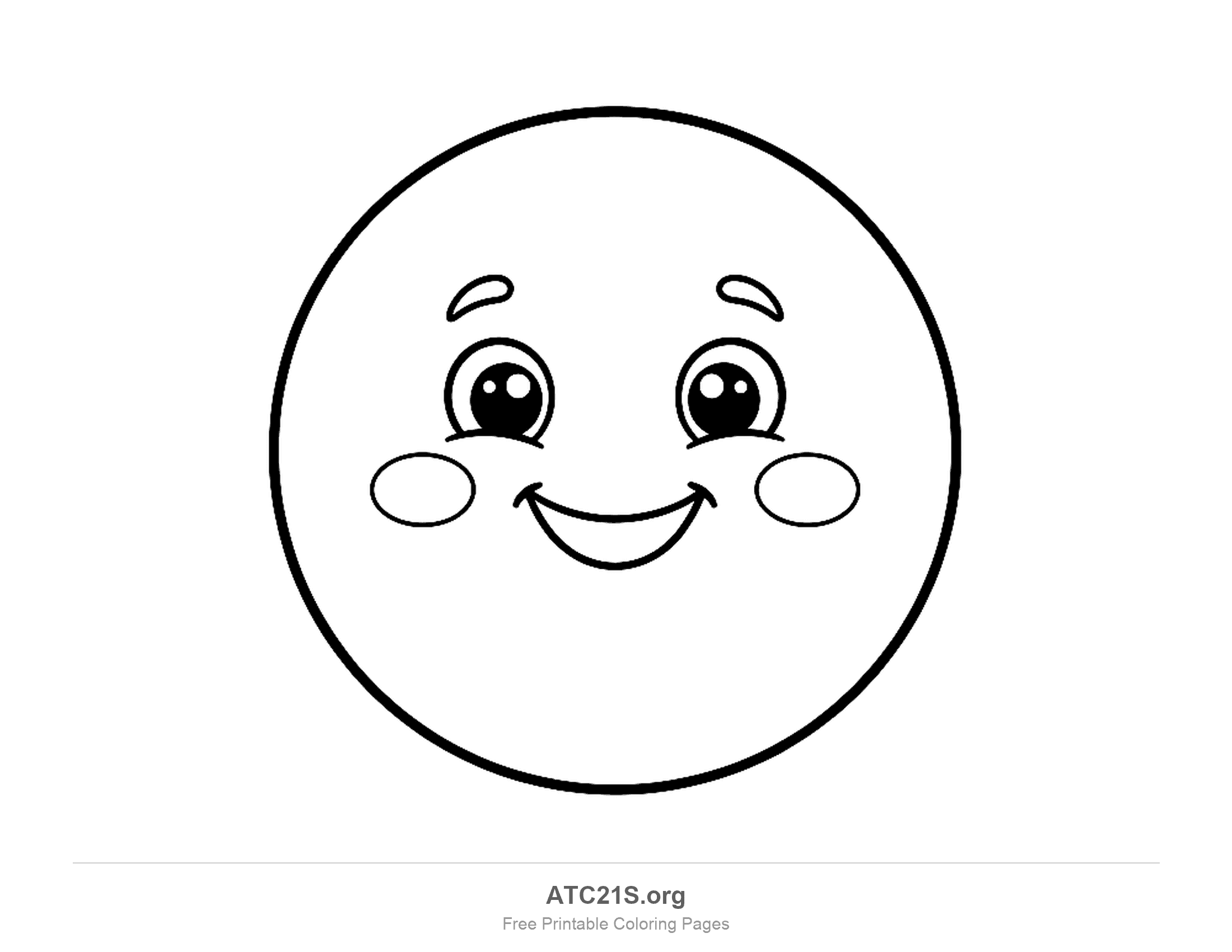
The eight designs get steadily harder. First is a smiling full moon: one big circle with round shiny eyes, arched eyebrows, oval cheeks and a wide smile, with thick outlines and huge open spaces for toddlers. Next is a tall crescent moon fast asleep, with closed eyes, long lashes and a small smile, drawn in thinner lines but with almost nothing inside the shape. The third is a crescent laughing so hard its eyes are squeezed shut and its open mouth shows a tongue, and the fourth is a crescent with big dark eyes full of little sparkling stars and a round button nose. After that there is more to do: a sleepy crescent wearing a striped nightcap with a fluffy pompom on the end; a slim crescent seen from the side, with one eye, a pointed nose and a happy open mouth along its inner curve and small craters dotted over its body; a chubby crescent with sparkly star-filled eyes, freckles, rosy cheeks and a few round craters; and finally a winking full moon with long lashes and a big grin, covered in craters of every size with tiny speckles of dust around them, for children who like a longer, careful page.
The craters on the last few sheets are the detail worth pausing on. They are real: the moon is covered in round holes left by rocks from space crashing into it, and because the moon has no air, wind or rain, they stay there for billions of years. The moon also makes no light of its own. It shines because sunlight bounces off it, and as it travels round the Earth we see different amounts of its sunlit side, which is why it seems to grow from a thin sliver to a full circle and shrink back again over about 29 and a half days. A simple rhyme helps here: if the bright side makes a D, the moon is getting bigger, and if it makes a C, it is getting smaller. That works in the Northern Hemisphere; south of the equator it is the other way round. Most of the crescents on these sheets are C-shaped, so children can check them against the sky. Shining a torch on a ball in a dark room shows the same thing, and the sun coloring pages make the other half of a day-and-night display.
Every sheet prints on landscape US Letter paper at 200 DPI, so the moon fills the page without being cut off. Plain copier paper is fine for crayons and colored pencils. If you are using markers or paint, slightly thicker card stock stops the colour bleeding through. It is worth doing on the side-view crater crescent, the freckled crescent and the winking crater moon, where the little craters, freckles and star-filled eyes put the lines closest together.
In the classroom these pages pair well with a lesson on day and night, space and the solar system, the phases of the moon, bedtime routines, or the letter M. The days of the week fit too, because Monday is named after the moon, and the Monday coloring page makes a good partner sheet. Night-time animals belong beside the moon: an owl coloring page for a bird that hunts by moonlight, the bat sheets for a mammal that flies in the dark, and the wolf pages, which also bust a myth, because wolves do not really howl at the moon; they lift their heads so the sound carries further. For a space display, the moon can circle a coloring page of planet Earth, keeping the same side turned towards it, just as the real moon always does. The moon can also hang above a dark tree coloring page with a few printable stars around it for a night scene. On rare bright nights a full moon can even make a faint moonbow, a rainbow made by moonlight, and the rest of the sky and the garden below are in the nature coloring pages.