NatureSky & Weather7 designsFree to print
print, color, learn
Free Star Coloring Pages
Seven free printable star coloring pages, from a plain five-pointed star in thick outlines for little hands to a detailed eight-pointed star packed with geometric patterns for older kids. Download the PNG or print straight from this page.
share:
pick a favourite
7 Star designs to color
Tap any sheet for a closer look, then download or print it.
Star Coloring Page - Puffy Rounded Star
Star Coloring Page - Sleepy Star Closed Eyes
Star Coloring Page - Smiling Star Arms And Legs
Star Coloring Page - Waving Star With Hands
Star Coloring Page - Smiling Star Swirling Streamers
Star Coloring Page - Detailed Eight Point Geometric
quick instructions
How to download and print
1. Pick your sheet
Preview any design below and choose the one you like best.
2. Print or download
Print straight from the page, or save the PNG to print later.
3. Color it in
Crayons, colored pencils or markers — plain paper works fine.
Every sheet is sized for landscape US Letter (11" x 8.5") at 200 DPI, so it fills the page without cropping. A4 works too — choose "fit to page" when printing.
while you color…
6 fun facts about the star
The sun is a star. It is the closest star to Earth, which is why it looks so big and bright.
Real stars are not star-shaped. They are huge, round balls of very hot glowing gas.
After the sun, the nearest star is Proxima Centauri. Its light takes more than four years to reach us.
Stars twinkle because their light is wobbled by moving air in the sky above us.
A star's colour shows how hot it is: blue-white stars are the hottest and red stars are the coolest.
Astronomers divide the whole sky into 88 constellations, groups of stars that make pictures like a bear, a hunter or a swan.
About the star coloring page
Stars are one of the first shapes children learn to draw, and one of the first things they wish on. They twinkle in bedtime songs, shine on top of holiday trees, get stuck on a good piece of homework and fill the sky on a clear night away from the streetlights. A star page works for almost any age because the shape is so simple: a toddler can fill a single star in a few minutes, while an older child can spend a long quiet stretch on a patterned one. The sheets here run from a plain outline to friendly stars with faces, arms and legs, and end with a star covered in geometric patterns.
Most children reach for yellow or gold, because that is how stars are drawn in books and on stickers. Real stars are more interesting than that. Look carefully on a dark night and some shine bluish white, some a soft yellow and a few orange or red, because a star's colour shows how hot it is. That makes any of those colours a good choice, and a pink, purple or rainbow star is just as welcome; a dark blue or black sky coloured in around the edge makes the star stand out. The shape that makes a picture read as a star is a ring of points spreading out from the middle, usually five, with the dents between them pointing back toward the centre.
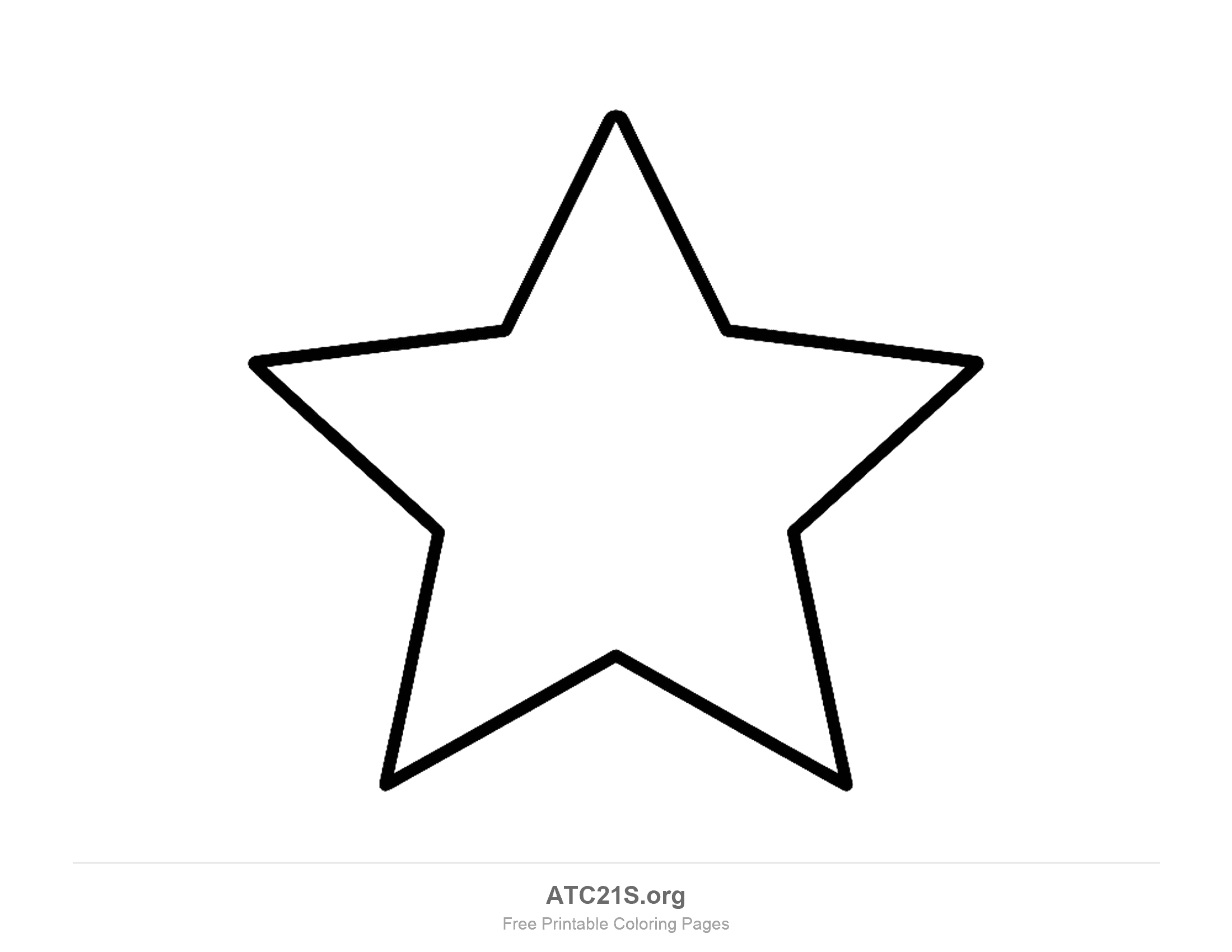
The seven designs get steadily harder. First is a plain five-pointed star with sharp points and a thick outline, one big space that suits toddlers still learning to stay inside the lines. Next is a puffy star with soft, rounded points like a cushion, with nothing inside it at all. The third is the same rounded shape with a sleepy face: closed eyes with long lashes, round rosy cheeks and a small smile. The fourth is a smiling star with dot eyes and oval cheeks, little arms held up at its sides and two short legs with round feet. After that there is a bit more to do: a waving star with shiny eyes, eyebrows and hands with fingers, drawn in a wobbly hand-drawn line with curved shine marks along its edges; a smiling star surrounded by wavy, curling streamers like ribbons or flames, each with a line down the middle; and finally an eight-pointed star filled with geometric patterns, with an octagon in the middle holding a small eight-pointed star, diamonds, stripes, chevrons and a ring of small circles, for children who like a long, careful page.
Counting the points is the detail worth pausing on. The first six stars all have five points, and children can touch each one and count to five, then compare with the last sheet, which has eight. Most of the stars we draw have five points, but real stars are not star-shaped at all. They are enormous balls of very hot glowing gas, so far away that they look like tiny dots, and they seem to twinkle because their light is shaken about as it passes through the moving air above us. The nearest star of all is our own sun, which is why it looks like a big bright circle instead of a dot, and the sun coloring pages are the natural place to talk about it. After sunset, the moon sheets and these stars make a full night sky together.
Every sheet prints on landscape US Letter paper at 200 DPI, so the star fills the page without being cut off. Plain copier paper is fine for crayons and colored pencils. If you are using markers or paint, slightly thicker card stock stops the colour bleeding through. It is worth doing on the streamer star and especially the eight-pointed pattern star, where the stripes, diamonds and small circles put the lines closest together.
In the classroom these pages pair well with a lesson on day and night, space, shapes, counting, reward charts, or the letter S. Five points go nicely with the number 5 coloring page, and the skip counting generator can make a counting-by-fives sheet for a row of stars. Stars turn up on flags too: the United States flag has fifty five-pointed stars, one for each state, and the Australia flag coloring page shows the Southern Cross with a big seven-pointed star beneath the Union Jack. Some songbirds that migrate at night find their way partly by the stars, so the bird coloring pages make a good partner sheet. A star or two can hang above a dark tree coloring page for a night scene, and the flowers, trees and the rest of the sky are in the nature coloring pages.