NatureSky & Weather7 designsFree to print
print, color, learn
Free Rainbow Coloring Pages
Seven free printable rainbow coloring pages, from a plain four-stripe arch in thick outlines for little hands to a striped ribbon rainbow that curls into a tight spiral for older kids. Download the PNG or print straight from this page.
share:
pick a favourite
7 Rainbow designs to color
Tap any sheet for a closer look, then download or print it.
Rainbow Coloring Page - Arch On Two Small Clouds
Rainbow Coloring Page - Six Stripe Arch Puffy Clouds
Rainbow Coloring Page - Smiling Face Rainbow
Rainbow Coloring Page - Wavy Ribbon Rainbow
Rainbow Coloring Page - Brick Block Rainbow With Clouds
Rainbow Coloring Page - Looping Spiral Ribbon
quick instructions
How to download and print
1. Pick your sheet
Preview any design below and choose the one you like best.
2. Print or download
Print straight from the page, or save the PNG to print later.
3. Color it in
Crayons, colored pencils or markers — plain paper works fine.
Every sheet is sized for landscape US Letter (11" x 8.5") at 200 DPI, so it fills the page without cropping. A4 works too — choose "fit to page" when printing.
while you color…
6 fun facts about the rainbow
A rainbow appears when sunlight shines through raindrops. Each drop bends the light and splits it into its colours.
To see a rainbow, the sun has to be behind you and the rain in front of you.
The colours always come in the same order: red, orange, yellow, green, blue, indigo and violet, with red on the outside.
A rainbow is really a full circle. From the ground the land hides the bottom half, but from an aeroplane you can sometimes see the whole ring.
In a double rainbow, the second, fainter bow has its colours the other way round, with red on the inside.
You can never reach the end of a rainbow, because it moves when you move. No two people see exactly the same rainbow.
About the rainbow coloring page
A rainbow is one of the few things in the sky that makes everyone stop and point. It appears without warning when the sun comes out during a shower, hangs there for a few minutes and then fades away, which makes it feel a little like magic to a small child. Rainbows are everywhere children look: in picture books and nursery decorations, on sticker charts and birthday cakes, painted in windows, and side by side with unicorns, hearts and stars on T-shirts and lunch boxes. They are also one of the most satisfying things to colour, because every stripe gets its own crayon and the finished picture is bright whatever colours a child picks. The seven sheets here run from a plain arch for toddlers to rainbows that wave, twist and curl like ribbons.
A real rainbow always has its colours in the same order: red on the outside, then orange, yellow, green, blue, indigo and violet on the inside. Indigo is a deep blue-purple and violet is the lighter purple at the inner edge, so a child with a basic crayon box can use dark blue and purple for those two. Following that order is a lovely way to colour these sheets, but it is not the only way. A pastel rainbow in pinks and lilacs, a rainbow in every shade of one colour or a rainbow in a child's own favourite colours is just as welcome, and the clouds can stay white or turn grey for a rain cloud, and the printable clouds have a whole set of sheets to practise both on. Not every sheet has exactly seven stripes, so it helps to count them first and decide which colours to leave out or use twice. What makes a picture read as a rainbow is a curved arch made of stripes lying side by side, and every design here keeps that idea, even when the arch bends into a wave or a spiral.
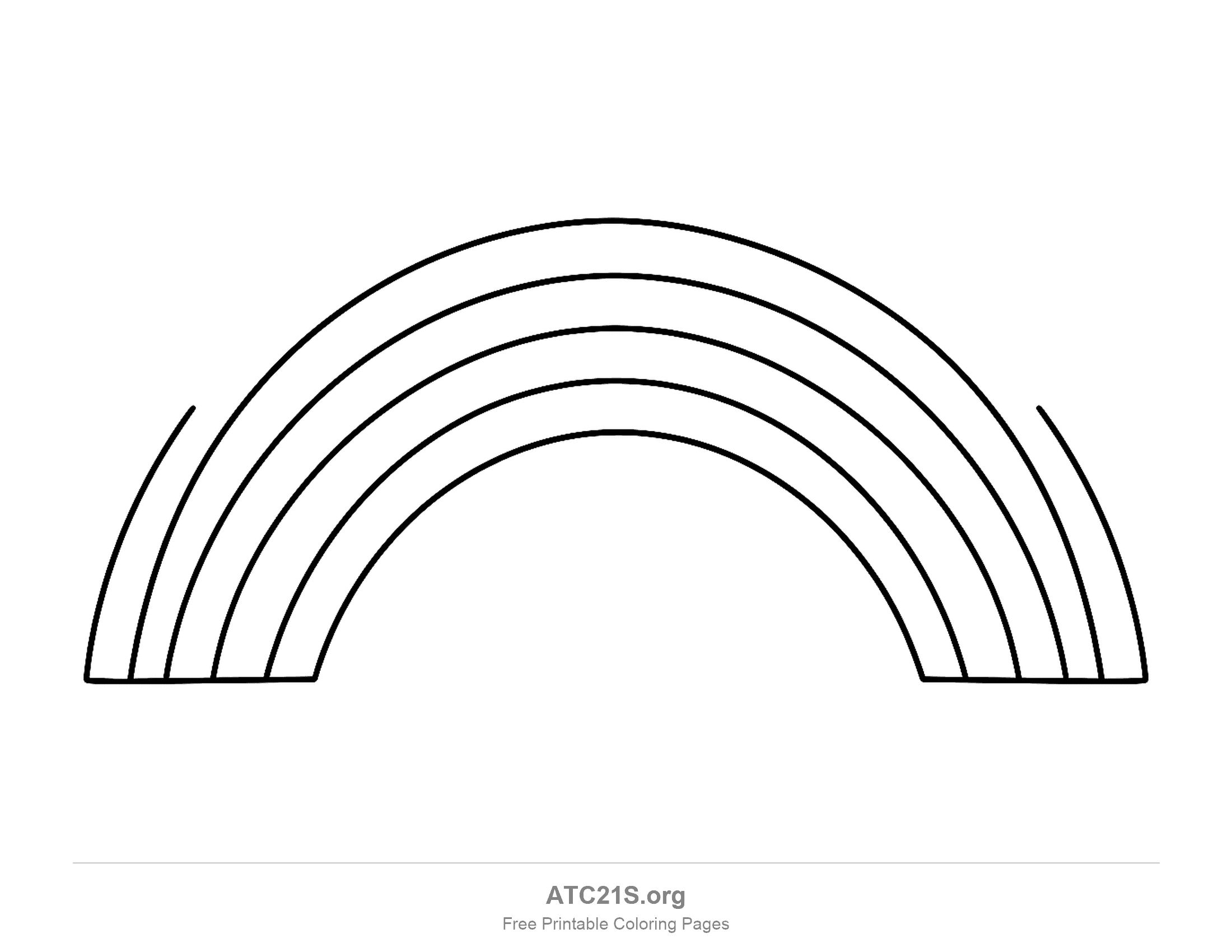
The seven designs get steadily harder. First is a plain arch of four wide stripes standing on a flat line at the ground, with a short extra curve outside each leg and nothing else on the page, drawn in thick outlines for toddlers still learning to stay inside the lines. Next is a four-stripe arch whose legs rest on two small puffy clouds, with a loose curved line under the arch and a short one on each side, like the lines a cartoonist draws to show something shining. The third sheet has six stripes, the closest any design here comes to seven, standing on two big puffy clouds with plenty of room inside each band. The fourth is a smiling rainbow with five stripes, big shiny eyes, oval rosy cheeks and a small smile drawn across the middle, its ends tucked into fluffy clouds. After that the drawings add more to do: a striped rainbow ribbon waving across the page in big S-shaped bends like a streamer in the wind, its narrow stripes curling round each bend; a rainbow built from blocks, with a ring of big rounded bricks on the outside, a smooth band and two rows of smaller bricks inside, resting on two large clouds; and finally a striped ribbon rainbow that rises in an arch, curls round into a tight spiral and drops down again into a curly tail, for children who like a long, careful page.
How a rainbow forms is the lesson that goes with these pages, and it needs only two things: sunshine and raindrops at the same time. Sunlight looks white, but it is really a mix of all the colours. When it shines into a raindrop, the light bends, bounces off the back of the drop and bends again on the way out, and each colour bends by a slightly different amount, so the white light fans out into a band of colours. Millions of drops doing this at once make the arch. That is why you see a rainbow with the sun behind you and the rain in front of you, usually in the morning or late afternoon when the sun is low, and why the sun coloring pages and the printable rain pages make the natural partner sheets. Children can make their own on a sunny day by standing with their back to the sun and spraying a fine mist from a hose, a good excuse to colour the printable garden afterwards, or by setting a glass of water on a sunny windowsill and looking for colours on the floor. In a real rainbow the colours blend smoothly into one another; it was the scientist Isaac Newton who divided them into seven names, partly so they would match the seven notes of a musical scale. The name Roy G. Biv, or the sentence Richard Of York Gave Battle In Vain, helps children remember the order, and counting the stripes on each sheet is a quick way to check whether there is room for all seven.
Every sheet prints on landscape US Letter paper at 200 DPI, so the whole design fits on the page with a clean margin. Plain copier paper is fine for crayons and colored pencils. If you are using markers or paint, slightly thicker card stock stops the colour bleeding through. It is worth doing on the wavy ribbon, the brick-block rainbow and the looping spiral, where the narrow stripes and small bricks put the lines closest together.
In the classroom these pages pair well with a lesson on weather, light and colour, colour mixing, spring showers, St Patrick's Day and the legend of the pot of gold at the end of the rainbow, or the letter R. Seven colours go nicely with the number 7 coloring page, and the color-by-number math generator makes a practice sheet where every answer unlocks a colour from the key. Flowers come in nearly every colour of the rainbow, so a row of flower coloring pages coloured red, orange, yellow, blue and purple makes a rainbow garden for the wall. One of Australia's best-known parrots is the rainbow lorikeet, named for its bright blue, green, orange and yellow feathers, which makes the parrot coloring pages a cheerful partner sheet. Rainbows can even appear at night: on rare bright nights the light of a full moon makes a faint moonbow, so the moon sheets belong in a sky display too. The rest of the sky, the flowers and the trees are in the nature coloring pages.