NaturePlants & Trees8 designsFree to print
print, color, learn
Free Garden Coloring Pages
Eight free printable garden coloring pages, from a bed of smiling flowers and tulips in bold outlines for little hands to a thatched cottage garden full of roses, pumpkins and sunflowers for older kids. Download the PNG or print straight from this page.
share:
pick a favourite
8 Garden designs to color
Tap any sheet for a closer look, then download or print it.
Garden Coloring Page - Zen Rock Garden With Little Trees
Garden Coloring Page - Raised Vegetable Beds
Garden Coloring Page - Fenced Fruit Orchard
Garden Coloring Page - Succulent And Cactus Rockery
Garden Coloring Page - Potting Bench With Herb Pots
Garden Coloring Page - Secret Garden Gate With Roses
Garden Coloring Page - Detailed Cottage Garden
quick instructions
How to download and print
1. Pick your sheet
Preview any design below and choose the one you like best.
2. Print or download
Print straight from the page, or save the PNG to print later.
3. Color it in
Crayons, colored pencils or markers — plain paper works fine.
Every sheet is sized for landscape US Letter (11" x 8.5") at 200 DPI, so it fills the page without cropping. A4 works too — choose "fit to page" when printing.
while you color…
6 fun facts about the garden
A carrot is a root. The part we eat grows under the soil, and only its feathery leaves show above it.
A tomato is really a fruit, because it grows from a flower and holds the plant's seeds.
Earthworms help a garden grow by tunnelling through the soil, letting in air and water and turning dead leaves into rich earth.
Mint spreads so fast through underground stems that many gardeners grow it in a pot to keep it from taking over.
In a Japanese rock garden, the lines raked into the gravel stand for flowing water and the rocks for islands or mountains.
The biggest pumpkins ever grown weighed more than a tonne, about as much as a small car.
About the garden coloring page
A garden is where all the single plants children know come together: flowers in a bed, vegetables in rows, fruit on the trees, herbs in pots by the back door, and a path running through the middle of it all. Most children have been in one, whether it is a backyard, a grandparent's vegetable patch, a school growing plot or a park, and plenty have planted something there and waited to see it come up. A garden page also has more to find than a page with one plant on it, so this set has eight different gardens: a flower bed, a Japanese rock garden, a vegetable patch, an orchard, a rockery, a potting bench, a walled garden behind an iron gate and a cottage garden.
Real gardens are mostly green, in dozens of shades from the pale lime of new lettuce to the dark green of a hedge, with brown soil, grey stones, sandy gravel and weathered wooden fences. Everything else is colour: red tomatoes, orange carrots and pumpkins, red and green apples, yellow-green pears, purple lavender, pink and white roses and yellow sunflowers. That is a perfectly good way to color these sheets. It is also fine to ignore it. A blue pumpkin, a striped watering can or a rainbow path is just as welcome, and the pots on the potting-bench and rockery sheets are a blank space for patterns. The shapes worth pointing out are the ones that make a picture look like a garden rather than a wild meadow: straight edges and rows, beds with sides, paths and stepping stones, fences, pots and gates. Someone planned it and looks after it.
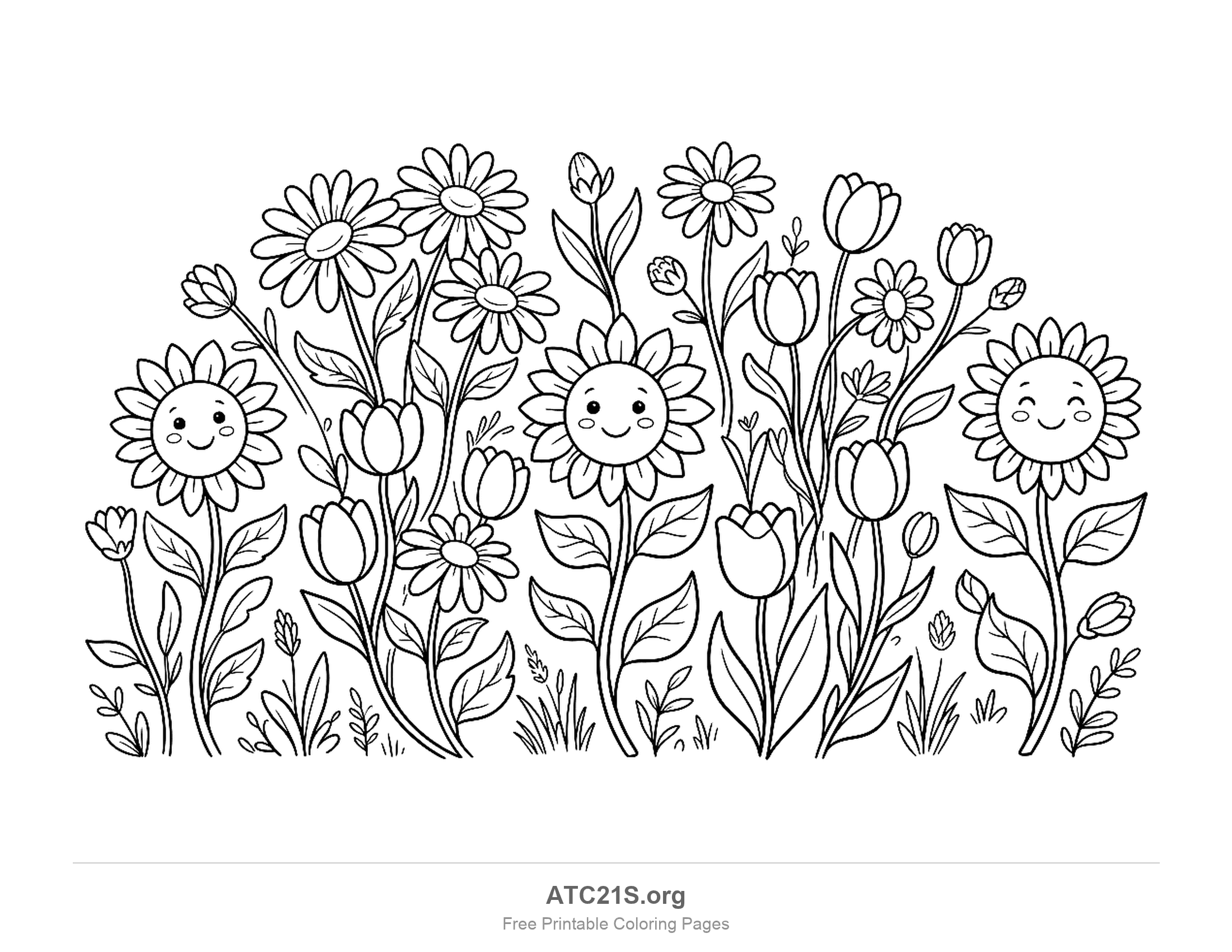
The eight designs get steadily harder. First is a flower bed in bold, clean outlines: three round flowers with smiling faces and rosy cheeks (one laughing with its eyes shut) stand among tulips, tulip buds and daisies on long leafy stems, with tufts of grass along the bottom, so toddlers can color one flower at a time. Then a Japanese rock garden in a square tray: four little twisting trees, each on an island of smooth pebbles in a corner, and a group of big rounded boulders in the middle, with swirling lines raked into the sand all around them. The third sheet is a vegetable patch of three wooden raised beds along a path: feathery carrot tops with the orange shoulders of the carrots showing and a trowel stuck in the soil, tomato plants tied to a frame of wooden stakes and hung with round tomatoes, and a bed of leafy lettuce heads. The fourth is a fruit orchard inside a picket fence, with four apple trees and two pear trees, berry bushes all along the fence, a few vegetable tops and flowers, and a stepping-stone path winding through. After that the drawings add more to do: a rockery of rosette succulents, round ribbed cacti, a prickly pear and spiky aloes, many of them in dotted clay pots, set among boulders and hundreds of pebbles; a wooden potting bench crowded with pots of tulips, daisies, roses, succulents and leafy plants, with two hanging baskets above and herb pots underneath labelled Mint, Oregano and Parsley; a pair of curly wrought-iron gates standing open in an old stone wall, under an arch of climbing roses, with big hosta leaves, ferns, foxgloves and lavender on either side and a cobbled path leading into the garden beyond; and finally a thatched stone cottage smothered in climbing flowers, with hollyhocks, pumpkins and gourds, a stepping-stone path, lanterns, a rose-covered arch, sunflowers, a birdhouse on a post, a watering can, and bees and butterflies in the air, for children who like a long, careful page.
Which part of the plant we eat is the thing worth pausing on, and the vegetable patch and the orchard make it easy. A carrot is a root, swollen with stored food under the soil, which is why only its feathery leaves show above the bed. A lettuce is a head of leaves, and so are the mint, oregano and parsley in the herb pots. A tomato is a fruit, because it grows from the flower and holds the seeds, and so are the apples, pears and berries in the orchard and the pumpkins in the cottage garden. Give children three colours, one for roots, one for leaves and one for fruit, and let them tick off every crop on the two sheets. The Japanese rock garden is a nice contrast: there is almost nothing to eat or pick in it. The raked sand stands for water and the boulders for islands or mountains, so a whole landscape is made out of stones, and it is a good page for a calm, slow color.
Every sheet prints on landscape US Letter paper at 200 DPI, so the garden fills the page without being cut off. Plain copier paper is fine for crayons and colored pencils. If you are using markers or paint, slightly thicker card stock stops the colour bleeding through. It is worth doing on the rockery, secret-gate and cottage-garden sheets, where the pebbles, the rose petals and the tangle of flowers round the cottage put the lines closest together.
In the classroom these pages pair well with a lesson on how plants grow, on where our food comes from, on looking after a school garden, on spring planting or harvest time, or on the letter G. Hand out the flower bed for a quick page and save the cottage garden for a quiet afternoon. Each garden also leads back to a single plant children can color on its own: the climbing roses round the iron gate and the cottage arch have their own rose coloring pages, the apple and pear trees in the orchard grow up full size on the tree coloring pages, the rockery's prickly pear and barrel cacti fill the cactus sheets, and the potted succulents, ferns and hanging baskets turn up again on the plant coloring pages. A vegetable patch has visitors too, and a rabbit nibbling the lettuces is the one every gardener watches out for. Beyond the garden wall, the landscape sheets carry on into the countryside, with a windmill farm, a barn on rolling hills and a thatched cottage in a wildflower meadow. The color-by-number math generator makes a practice sheet to go with it, and the flowers, skies and landscapes are in the rest of the nature coloring pages.