NatureSky & Weather8 designsFree to print
print, color, learn
Free Tornado Coloring Pages
Eight free printable tornado coloring pages, from a sleepy smiling funnel in thick, simple outlines for little hands to a swirling tornado full of tiny stars beneath a big storm cloud for older kids. Download the PNG or print straight from this page.
share:
pick a favourite
8 Tornado designs to color
Tap any sheet for a closer look, then download or print it.
Tornado Coloring Page - Happy Funnel On The Ground
Tornado Coloring Page - Bubbly Coils Under A Cloud
Tornado Coloring Page - Cartoon Face With Wind Swirls
Tornado Coloring Page - Wide Spinning Funnel
Tornado Coloring Page - Tall Twisting Funnel From A Cloud
Tornado Coloring Page - Fluffy Cloud Crown With Dust
Tornado Coloring Page - Starry Swirl Under A Storm Cloud
quick instructions
How to download and print
1. Pick your sheet
Preview any design below and choose the one you like best.
2. Print or download
Print straight from the page, or save the PNG to print later.
3. Color it in
Crayons, colored pencils or markers — plain paper works fine.
Every sheet is sized for landscape US Letter (11" x 8.5") at 200 DPI, so it fills the page without cropping. A4 works too — choose "fit to page" when printing.
while you color…
6 fun facts about the tornado
A tornado only counts as a tornado when its spinning funnel touches the ground. Until then it is called a funnel cloud.
The United States has more tornadoes than any other country, around 1,200 in a typical year.
Most tornadoes last less than ten minutes.
A tornado that forms over a lake or the sea is called a waterspout.
Tornadoes are rated from EF0, the weakest, to EF5, the strongest, by looking at the damage they leave behind.
North of the equator, most tornadoes spin anticlockwise, and south of it most spin clockwise.
About the tornado coloring page
A tornado is a column of air spinning very fast, reaching all the way from a thunderstorm cloud down to the ground. Children are fascinated by them: the twisting funnel shape is easy to recognise, it turns up in films, picture books and weather reports, and the word "twister" is fun to say. A tornado is also a big feeling for some children, because it is powerful and a little scary, and colouring one in is a calm, friendly way to talk about it. Three of the sheets here turn the funnel into a cartoon character with a smiling face, and the other five show the spinning shape on its own, some with the storm cloud it comes from.
Real tornadoes have no colour of their own. They are made of spinning air, and we only see them because the funnel fills with cloud droplets and with the dust, soil and leaves it lifts from the ground, so a tornado can look white, grey, dark blue-grey or even reddish-brown over red earth. Grey and dark blue are the classic choice, a green or purple stormy sky behind it looks dramatic, and the stars on the last sheet are a good place for yellow, but a rainbow twister or a pink one is just as welcome. What makes the shape read as a tornado is a wide top that narrows down to a thin point, wrapped in loops and bands that show the air going round and round, and every design here is built on that funnel.
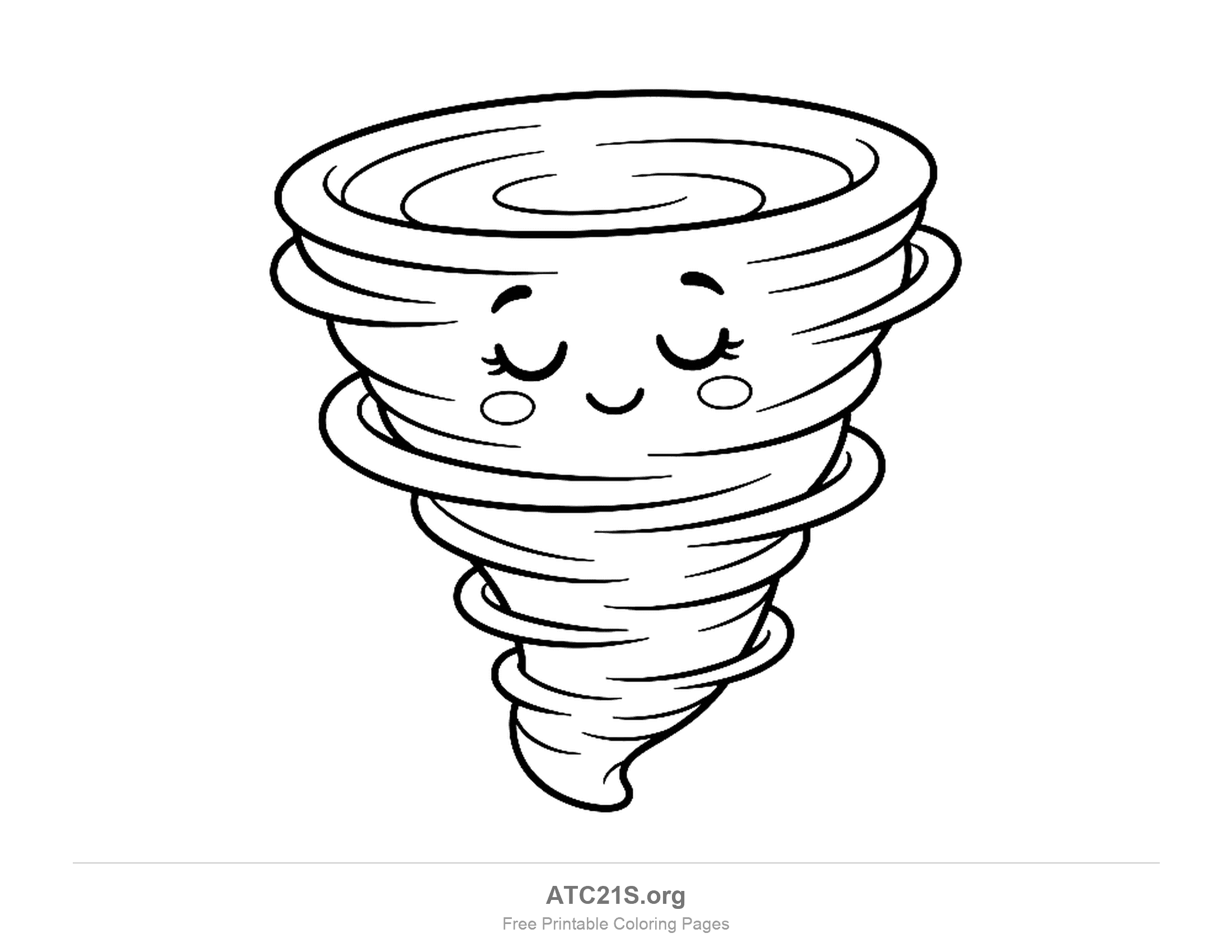
The eight designs get steadily harder. First is a sleepy tornado in the thickest outlines of the set: a stack of rounded rings narrowing to a curled tip, with closed eyes with little lashes, round rosy cheeks and a gentle smile, an open oval top with a spiral inside and three loose wind rings looped around its body, so there are a few big spaces and it suits toddlers. Next is a happy funnel with big shiny eyes, raised eyebrows and a wide open smile, a puffy curled rim on top and wind bands wrapping round its middle, its pointed tip resting on an oval shadow on the ground. The third sheet has no face: fat, rounded coils stacked like a spring under a big puffy cloud, with round ring-shaped loops where the coils turn, all drawn in bold lines with plenty of room to colour. The fourth is a cheeky cartoon tornado with big round eyes, eyebrows and a laughing grin, a spiral on its top and curly wisps of wind flying off on every side. After that the drawings add more to do: a wide, faceless funnel whose huge spiral top flares out across the page, with ribbons of wind looping round it all the way down to where its tip touches a long ground line; a tall, thin funnel twisting down like a corkscrew from a puffy cloud full of curls and landing in a swirl of rings on the ground; a funnel crowned with a ring of fluffy cloud puffs and little curls, with speed lines along its bands and small specks of dust kicked up around its tail; and finally a wide tornado beneath a big storm cloud, made of overlapping bands of wind with a dozen or so little stars whirling around it and a puff of dust where it touches down, for children who like a long, careful page.
How a tornado forms is the lesson that goes with these pages, and it starts with a thunderstorm. On a warm, damp day, warm air near the ground rises fast into the cold air high above and builds a towering storm cloud. If the wind blows at different speeds and from different directions at different heights, it can set a wide tube of air rolling sideways near the ground, a bit like a pencil rolling across a table. The storm's rising air can tip that rolling tube upright, so the whole storm cloud starts to turn slowly, and sometimes a narrow, fast-spinning funnel stretches down from the bottom of the cloud. While it hangs in the air it is called a funnel cloud; it only becomes a tornado when it touches the ground. The most important part of the lesson is the reassuring one: tornadoes are rare in most places, weather forecasters watch for them very carefully, and every family can have a simple plan. When a tornado warning sounds, go inside to the lowest floor of a strong building, into a small room in the middle with no windows, such as a bathroom, a closet or a basement, and cover your head. Practising the plan once, like a fire drill, turns a frightening idea into something children know how to handle.
Every sheet prints on landscape US Letter paper at 200 DPI, so the funnel fills the page without being cut off. Plain copier paper is fine for crayons and colored pencils. If you are using markers or paint, slightly thicker card stock stops the colour bleeding through. It is worth doing on the tall twisting funnel, the fluffy cloud crown and the starry swirl, where the thin wind bands, the little cloud curls, the dust specks and the tiny stars put the lines closest together.
In the classroom these pages pair well with a lesson on weather, storms, staying safe, spirals and spinning, or the letter T. The weather coloring pages are the natural place to start, because their storm cloud with a lightning bolt is exactly the kind of thunderstorm a tornado grows from, and their windy-day sheet shows a gentler wind for comparison. Every tornado hangs from a cloud, so a few of the cloud sheets make a good before-and-after: a puffy fair-weather cloud on one side and a storm cloud with a twister on the other. The same storms usually bring heavy showers, which is where the printable rain fits in. A family safety plan includes pets, and many dogs seem to sense a storm coming before people do, growing restless or hiding under a bed, so a dog coloring page is a gentle reminder to bring the dog into the safe room too. The sun, the rainbow and the rest of the sky are in the nature coloring pages.