BirdsGarden8 designsFree to print
print, color, learn
Free Peacock Coloring Pages
Eight free printable peacock coloring pages, from a round baby peachick with thick outlines to a full fan display packed with eye-spot feathers. Download the PNG or print straight from this page.
share:
pick a favourite
8 Peacock designs to color
Tap any sheet for a closer look, then download or print it.
Peacock Coloring Page - Cute Sitting Curled Tail
Peacock Coloring Page - Cute Wings Spread Fan
Peacock Coloring Page - Walking Side Profile
Peacock Coloring Page - Looking Over Shoulder
Peacock Coloring Page - Strutting Raised Train
Peacock Coloring Page - Detailed Crest Portrait
Peacock Coloring Page - Detailed Full Fan Display
quick instructions
How to download and print
1. Pick your sheet
Preview any design below and choose the one you like best.
2. Print or download
Print straight from the page, or save the PNG to print later.
3. Color it in
Crayons, colored pencils or markers — plain paper works fine.
Every sheet is sized for landscape US Letter (11" x 8.5") at 200 DPI, so it fills the page without cropping. A4 works too — choose "fit to page" when printing.
while you color…
6 fun facts about the peacock
Only male peacocks grow the big fan. Females, called peahens, are brown and grey so they can hide in the grass.
A peacock's train can be more than 5 feet (1.5 m) long — longer than the rest of the bird.
The spots on the train are called eyespots. They are for showing off to peahens, not for seeing.
Baby peacocks are called peachicks, and they can walk and find food on the day they hatch.
Peacocks can fly. They flap up into trees at night to roost, even with that heavy train.
The Indian peacock is the national bird of India.
About the peacock coloring page
Peacocks are large ground-walking birds native to India and Sri Lanka, now kept in parks, gardens and zoos around the world. The bird children recognise is the male, with a tall fan of eye-spotted feathers called a train. The female, a peahen, is mostly brown, and a baby is a peachick. They roost in trees at night and spend the day walking on the ground, fanning that train when they want to show off.
Colour is the whole point of a peacock page. A real Indian peacock has a metallic blue neck and a train of green and bronze feathers, each ending in a chestnut-and-blue eye. There is no single "right" peacock colour, so children can copy that palette or invent a rainbow bird. Point out the little crest on top of the head and the eyespots on the train: colouring the centre of each "eye" a different shade from the ring around it makes even a simple page look finished.
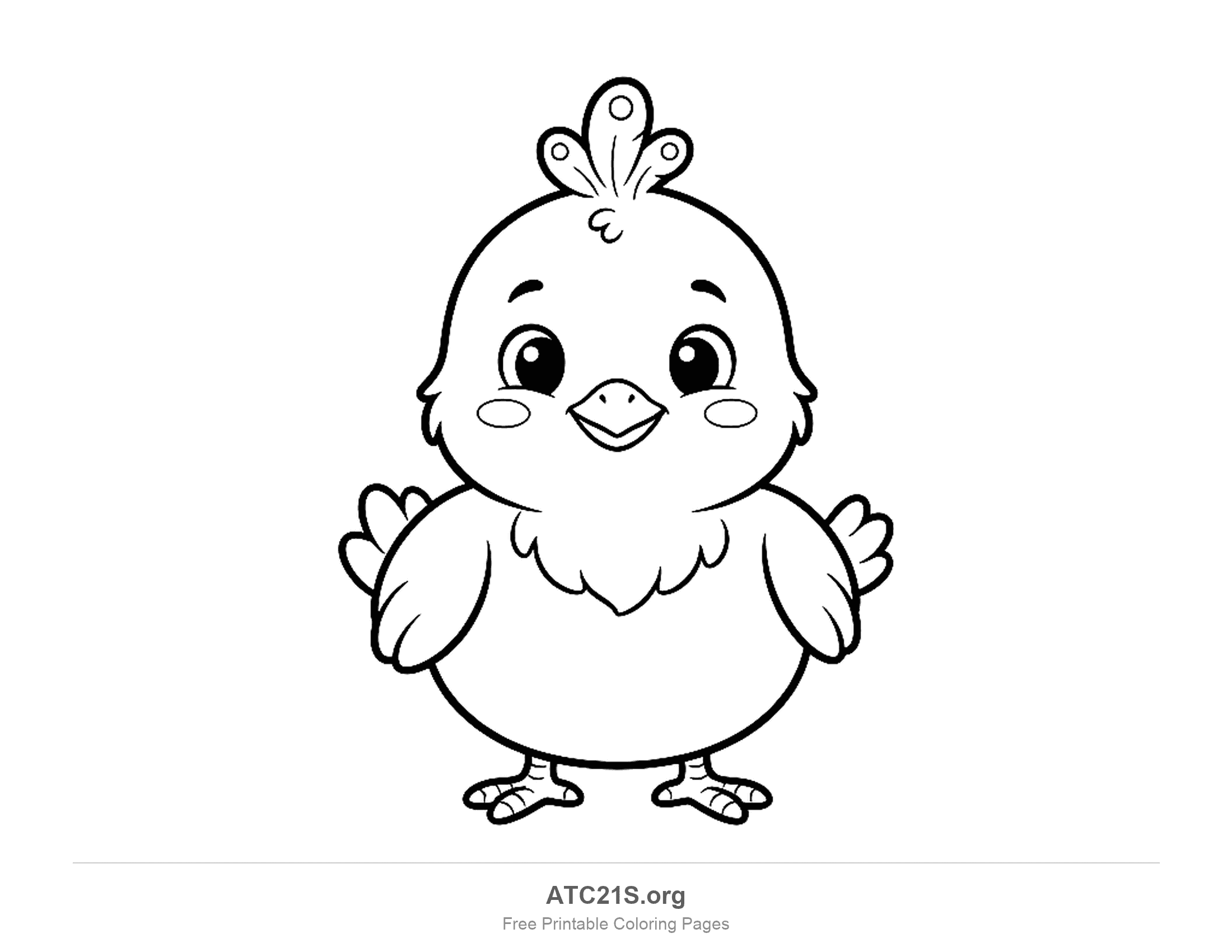
The eight designs run from easiest to hardest. The round baby peachick comes first — thick outlines, huge eyes and a simple three-feather crest, right for toddlers. Then a cute peacock sitting with its train curled around it, and a smiling cartoon peacock with both wings spread and a simple fan. A walking peacock in side view sits in the middle, with a trailing train of eyespots. After that the detail climbs: a peacock looking over its shoulder with a hanging train, one strutting with the train half-raised, a close-up head portrait packed with tiny scale feathers, and finally a full fan display whose every eyespot is a separate shape for children who like a long, careful project.
Every sheet prints on landscape US Letter paper at 200 DPI, so the peacock fills the page without being cut off. Plain copier paper is fine for crayons and colored pencils. Use slightly thicker card stock for markers or paint on the last two designs, where the narrow gaps between crest scales and fan feathers can bleed shut on thin paper.
In the classroom these pages pair well with a lesson on birds, on India, on the letter P, or on how animals use colour to show off. Laying the peachick next to the full fan is a simple way to show that baby peacocks do not have a train. The smiling wings-spread sheet makes a cheerful display; the detailed fan can fill a whole quiet afternoon. The hummingbird coloring pages are the other garden bird in the set, the parrot sheets are just as colourful, and the flamingo pages add pink to the palette. The bird coloring pages cover farm, forest and polar birds too. Print a few different designs and let each child pick the one that matches their patience that day.
keep coloring