AnimalsOcean8 designsFree to print
print, color, learn
Free Shark Coloring Pages
Eight free printable shark coloring pages, from a chunky-outline baby shark for little hands to a finely spotted whale shark for older kids. Download the PNG or print straight from this page.
share:
pick a favourite
8 Shark designs to color
Tap any sheet for a closer look, then download or print it.
Shark Coloring Page - Cute Front View Smiling
Shark Coloring Page - Cute Leaping
Shark Coloring Page - Simple Swimming
Shark Coloring Page - Hammerhead Swimming
Shark Coloring Page - Sawshark Swimming
Shark Coloring Page - Thresher Long Tail
Shark Coloring Page - Detailed Spotted Whale Shark
quick instructions
How to download and print
1. Pick your sheet
Preview any design below and choose the one you like best.
2. Print or download
Print straight from the page, or save the PNG to print later.
3. Color it in
Crayons, colored pencils or markers — plain paper works fine.
Every sheet is sized for landscape US Letter (11" x 8.5") at 200 DPI, so it fills the page without cropping. A4 works too — choose "fit to page" when printing.
while you color…
6 fun facts about the shark
Sharks have been swimming in the ocean for about 400 million years — they were here long before the dinosaurs.
A shark's skeleton is made of cartilage, the same flexible stuff as your ears and the tip of your nose, not bone.
The whale shark is the biggest fish in the world and can grow longer than a school bus.
When a shark loses a tooth, a new one moves up to take its place — some sharks go through thousands of teeth in a lifetime.
A hammerhead shark's eyes sit at the ends of its wide head, so it can see almost all the way around.
Baby sharks are called pups, and some kinds hatch from leathery egg cases that people nickname mermaid's purses.
About the shark coloring page
Sharks are fish that live in oceans all over the world, from warm coral reefs to the cold deep sea. There are more than 500 kinds, and they come in almost every size: a dwarf lanternshark could sit in your hand, while a whale shark is longer than a school bus. Unlike most fish they have a skeleton made of cartilage — the same flexible stuff as your ears and the tip of your nose — which is one of the first things children find surprising.
Grey, blue-grey and sandy brown are the colours most real sharks wear, usually with a paler belly. That is a good starting palette, but these pages do not have one "right" colour. The cartoon baby and the front-on smiling shark look just as good in bright blues, greens or a rainbow mix. The whale shark is the one to colour more carefully: real ones are dark grey with a scatter of pale spots and stripes, a pattern unique to each animal, a bit like a fingerprint.
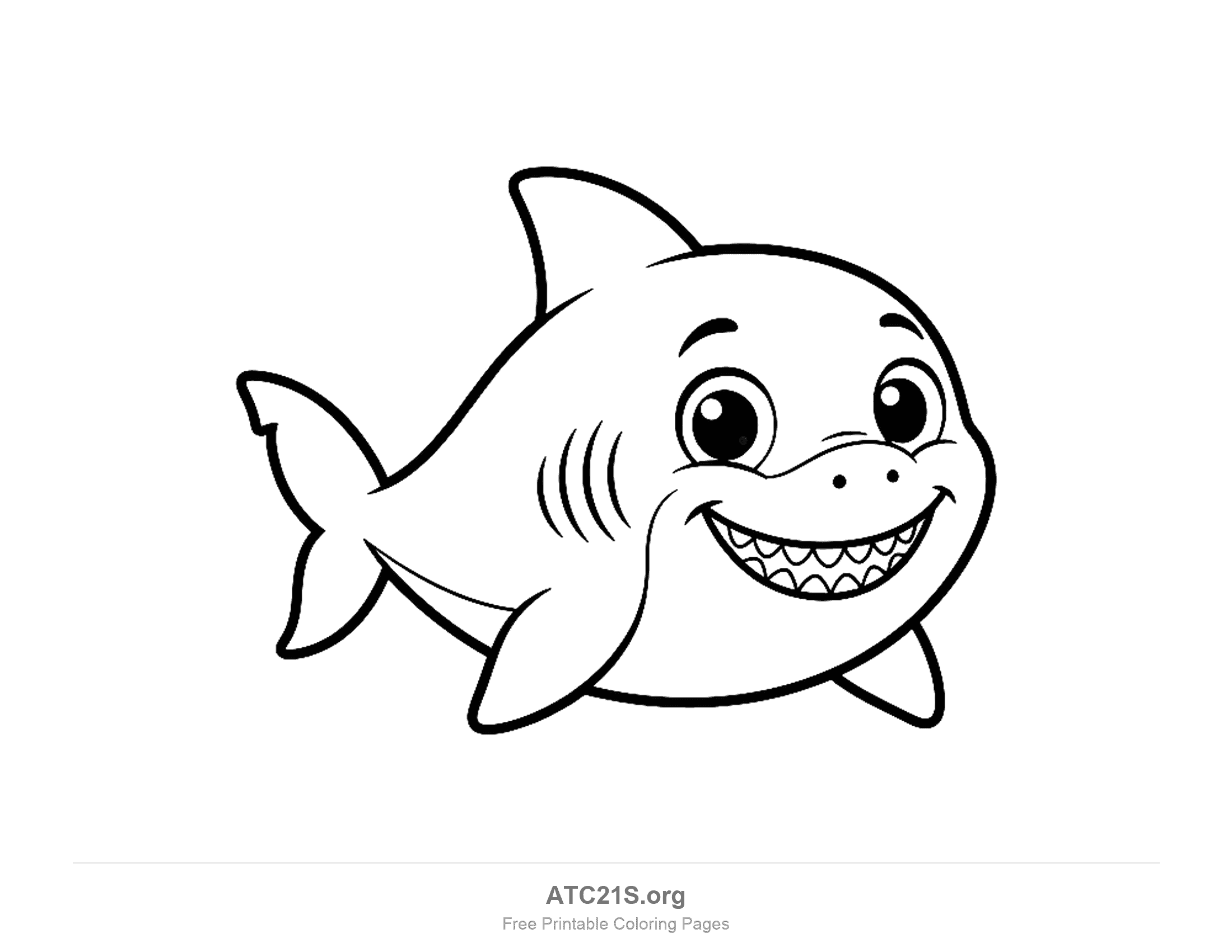
The eight designs get steadily harder and also show different kinds of shark. The first three are the easy ones — a chunky baby shark with huge eyes, a round-faced shark swimming straight at you, and a leaping cartoon shark with a big grin. Thick outlines and wide open shapes suit toddlers and preschoolers still learning to stay inside the lines. Next is a simple swimming shark with almost no interior detail. Then come three real species children can name: a hammerhead with its wide flat head, a sawshark with a long toothed snout, and a thresher whose tail curves in a huge sickle over its back, with bubbles around it. The last sheet is the long project: a whale shark whose back is covered in spots, stripes and small shapes for children who want a careful, sit-down page.
Every sheet prints on landscape US Letter paper at 200 DPI, so the shark fills the page without being cut off. Plain copier paper is fine for crayons and colored pencils. If you are using markers or paint, slightly thicker card stock stops the colour bleeding through — worth doing on the whale shark sheet, where the spots sit close together.
In the classroom these pages pair well with a lesson on ocean habitats, on food chains, or on the letter S. Laying the hammerhead, the sawshark, the thresher and the whale shark side by side is a simple way to show that "shark" is a whole family of animals, not one shape. Print two or three different designs and let each child pick: the baby shark is finished in a few minutes, while the spotted whale shark can fill a whole quiet afternoon, which keeps a mixed-age table busy at the same time. The whale and dolphin pages show the ocean mammals that share this water, and the animal coloring pages has everything on land.
Sharks are also an easy opening for a first conversation about looking after the ocean. Many children arrive thinking every shark is a movie villain; colouring a gentle whale shark or a smiling baby one is a calm way to talk about how most sharks are not dangerous to people, and how some kinds now need protecting.