FoodsFruit8 designsFree to print
print, color, learn
Free Apple Coloring Pages
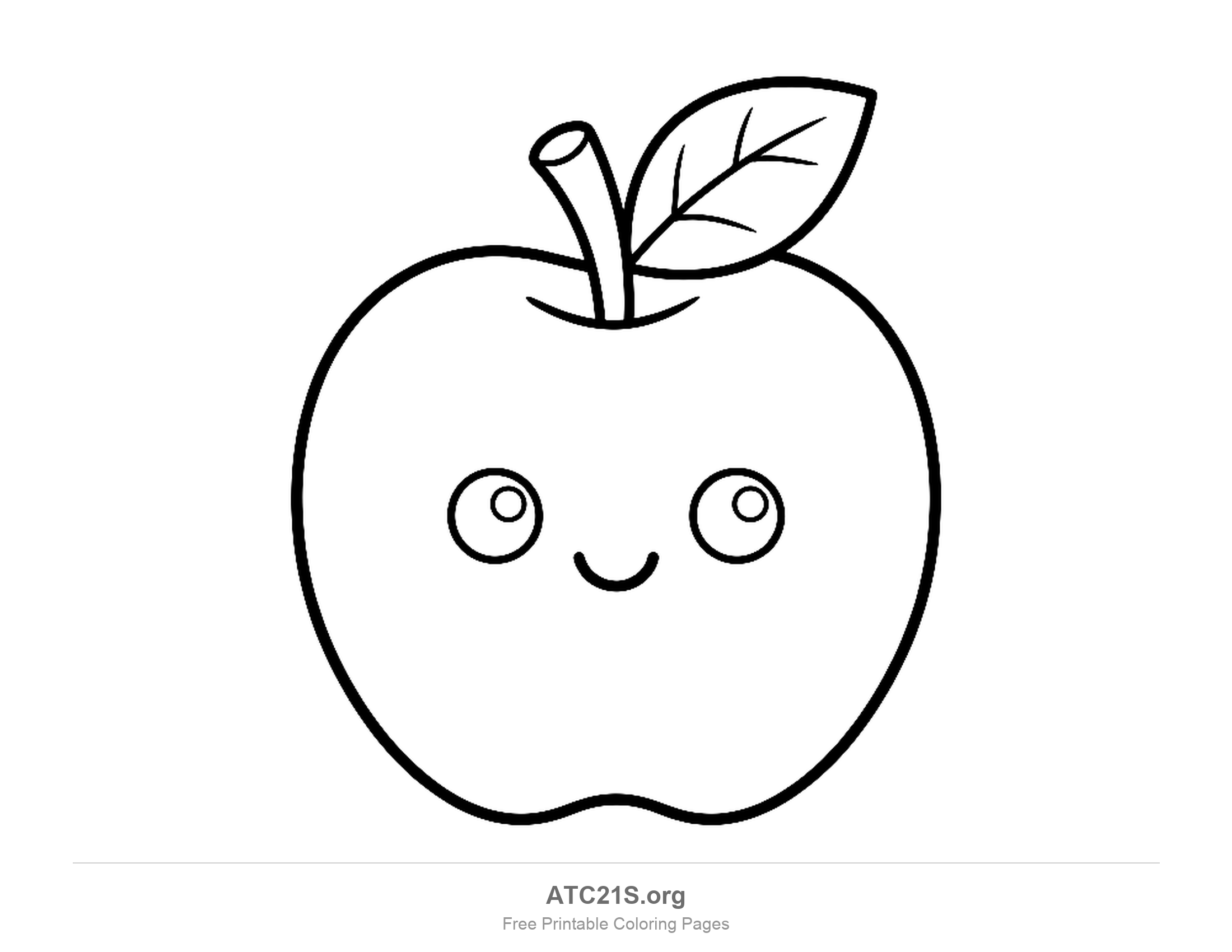
Eight free printable apple coloring pages, from a big smiling apple with almost nothing inside the lines to a halved apple, a star-shaped cross section and a tilted apple with finely veined leaves. Download the PNG or print straight from this page.
share:
pick a favourite
8 Apple designs to color
Tap any sheet for a closer look, then download or print it.
Apple Coloring Page - Simple Whole Apple
Apple Coloring Page - Apple With a Worm
Apple Coloring Page - Apple With a Bite Taken Out
Apple Coloring Page - Halved Apple With Seeds
Apple Coloring Page - Star Cross Section
Apple Coloring Page - Single Apple Wedge
Apple Coloring Page - Tilted Apple With Twin Leaves
quick instructions
How to download and print
1. Pick your sheet
Preview any design below and choose the one you like best.
2. Print or download
Print straight from the page, or save the PNG to print later.
3. Color it in
Crayons, colored pencils or markers — plain paper works fine.
Every sheet is sized for landscape US Letter (11" x 8.5") at 200 DPI, so it fills the page without cropping. A4 works too — choose "fit to page" when printing.
while you color…
6 fun facts about the apple
Cut an apple across its middle instead of top to bottom and the core makes a five-pointed star.
There are more than 7,500 kinds of apple in the world, and they come in red, green, yellow and even almost-purple.
About a quarter of an apple is air, which is why apples float — that is how bobbing for apples works.
Apple seeds are sometimes called pips, and a tree grown from one will not make the same apple as the one you ate.
The world's oldest known apple tree was planted in 1647 in what is now New York City and lived for over 200 years.
Apples belong to the rose family, so they are cousins of pears, cherries and strawberries.
About the apple coloring page
An apple is the fruit of the apple tree, which grows across most of the cooler parts of the world and has been farmed for thousands of years. What children usually picture is one shape — round, red, with a stalk and a leaf on top — but an apple looks completely different depending on how you cut it. This page shows several of those views next to each other: a whole apple, a half with the core showing, a single wedge, and the surprising five-pointed star you only see when you slice one across the middle.
Apples are a good first lesson in shading, because a real apple is never one flat color. Encourage children to start with a base of red, green or yellow, then press harder along one edge to make the shadowed side and leave a small patch almost white where the light hits. The stalk takes brown, the leaf a deeper green than the fruit, and the flesh inside a cut apple is a pale cream or ivory rather than white — a light yellow pencil with a very soft touch works well. Crayons, colored pencils and markers all suit these sheets equally.
The eight designs run from very easy to genuinely detailed. The first three — a smiling kawaii apple with two dot eyes, a plain whole apple with one veined leaf, and an apple with a friendly worm poking out of the side — are thick-lined and mostly open space, which is right for toddlers and preschoolers still learning to stop at an edge. The middle sheets ask for a little more: a cartoon apple with a face and a scalloped bite taken out of it showing two seeds, a halved apple with the core and seed pockets drawn in, and the star cross section, which is a wide plain circle with an intricate five-petal star at its centre. The last two are for older children — a thick crescent wedge with fine feathery lines around the core, and a tilted apple crowned with two serrated leaves whose veins fan out one by one.
Every sheet prints on landscape US Letter paper at 200 DPI, so the apple fills the page without being cropped. Plain copier paper is fine for crayons and colored pencils. If children are using markers or paint, thicker card stock is worth the swap — it matters most on the wedge and the twin-leaf sheets, where the thin lines sit close together and wet color can run one shape into the next.
In the classroom, apples are a natural fit for autumn, harvest and back-to-school displays, and for the letter A. The halved apple and the star cross section pair beautifully with a real apple cut open in front of the class: slice one down through the stalk and one across the middle, and let children match each cut to the sheet in front of them. The star sheet is also the classic starting point for apple printing — cut, dip in paint, stamp, then color the printed page afterwards. For counting and sorting, print the whole-apple sheet several times and have children color a set number red, green and yellow.
If you are handing these out to a mixed-age group, spread the sheets around rather than giving everyone the same one. A three-year-old will finish the smiling apple happily in a few minutes; an eight-year-old can spend a long stretch on the leaves and the wedge and still find lines left to follow.