Country Flags2 designsFree to print
print, color, learn
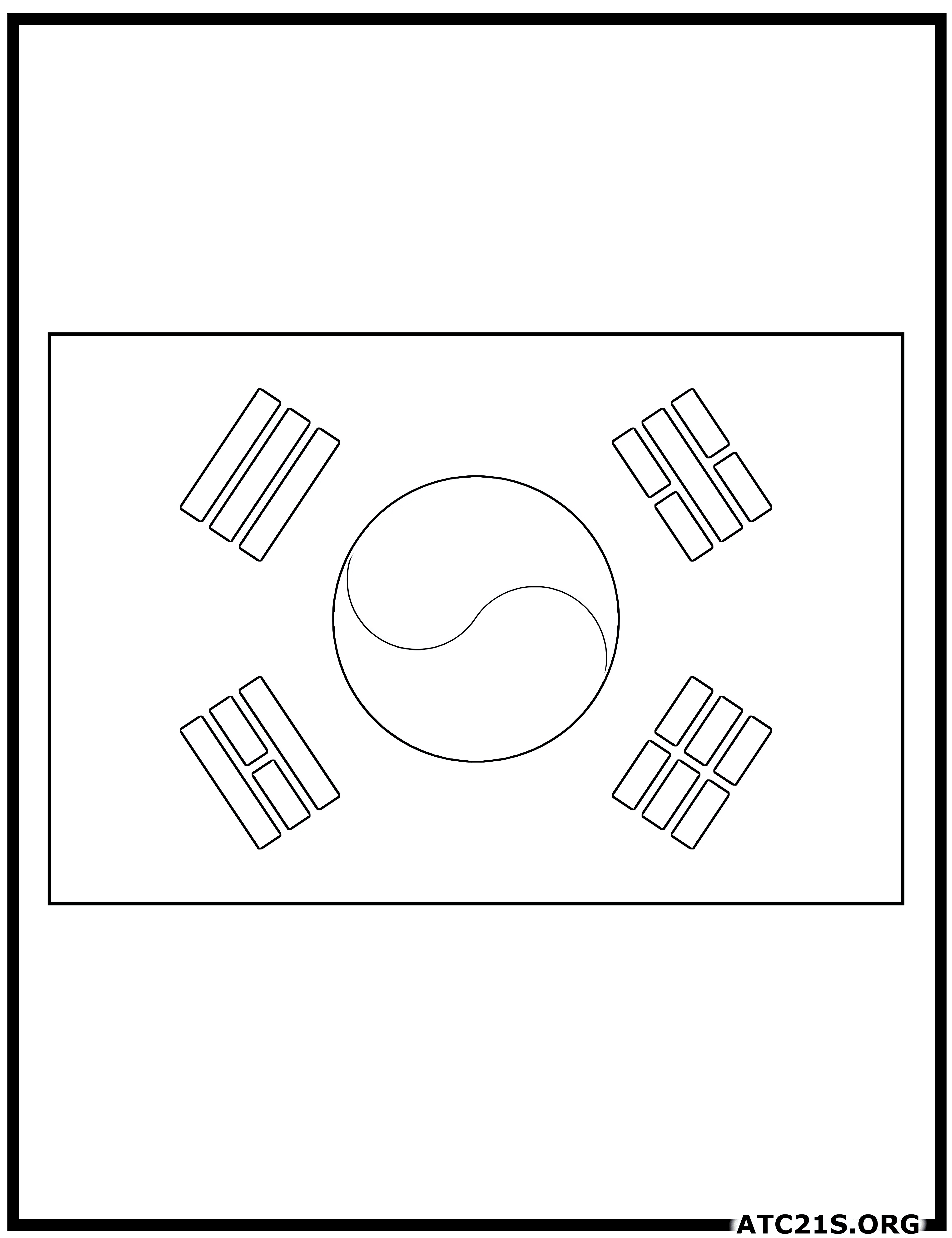
South Korea Flag Coloring Page
Learn about the flag of South Korea with this free printable coloring page. Perfect for teaching children about world geography and flags!
share:
pick a favourite
2 Country Flags designs to color
Tap any sheet for a closer look, then download or print it.
South Korea Flag Colored
quick instructions
How to download and print
1. Pick your sheet
Preview any design below and choose the one you like best.
2. Print or download
Print straight from the page, or save the PNG to print later.
3. Color it in
Crayons, colored pencils or markers — plain paper works fine.
Every sheet is sized for landscape US Letter (11" x 8.5") at 200 DPI, so it fills the page without cropping. A4 works too — choose "fit to page" when printing.
About this coloring page
The flag of South Korea, also known as the Taegeukgi, is a national symbol that represents the country's identity and history. It consists of a white background with a red and blue Taegeuk in the center, surrounded by four black trigrams.
The Taegeuk, which is the central design of the flag, represents the concept of yin and yang, symbolizing the harmony and balance of the universe. The red section represents yang, which represents positivity, warmth, and passion, while the blue section represents yin, symbolizing negativity, coolness, and calmness. The two halves of the Taegeuk are interconnected, representing the continuous movement and interaction between these opposing forces.
The four black trigrams, known as Gwae, are located in each corner of the flag. These trigrams are derived from the ancient Chinese philosophy of the I Ching, which represents the fundamental principles of the universe. Each trigram represents one of the four elements: heaven, earth, fire, and water. The trigrams also symbolize the four cardinal directions: east, west, south, and north.
The flag of South Korea has a long history that dates back to the late 19th century. During the Joseon Dynasty, which ruled Korea from 1392 to 1897, the country used various flags, including the Taegukgi, which featured a similar design to the current flag. However, it was not officially adopted as the national flag until 1883.
After the Japanese occupation of Korea in 1910, the use of the Taegukgi was prohibited, and the Japanese flag was imposed as the official flag. However, during the Korean independence movement in the early 20th century, the Taegukgi became a symbol of resistance against Japanese rule. It was widely used during protests and demonstrations, representing the desire for independence and national identity.
Following the liberation of Korea from Japanese rule in 1945, the Taegukgi was officially reinstated as the national flag. Since then, it has remained the official flag of South Korea, representing the country's values of harmony, balance, and unity.
The flag of South Korea holds great significance for the Korean people, symbolizing their history, culture, and aspirations. It is proudly displayed on various occasions, including national holidays, sporting events, and official ceremonies, serving as a powerful symbol of national pride and identity.
keep coloring